Singularity
Introduction
Approaching Singularity: Third Derivatives, Nonlinear Collapse, and Coupled Climate–Economic Instability
Advances in technology, modeling, and artificial intelligence have significantly improved our ability to understand and track the accelerating dynamics of climate change. These tools have provided new insight into how quickly complex systems can evolve—and how difficult it may be to keep pace with that acceleration.
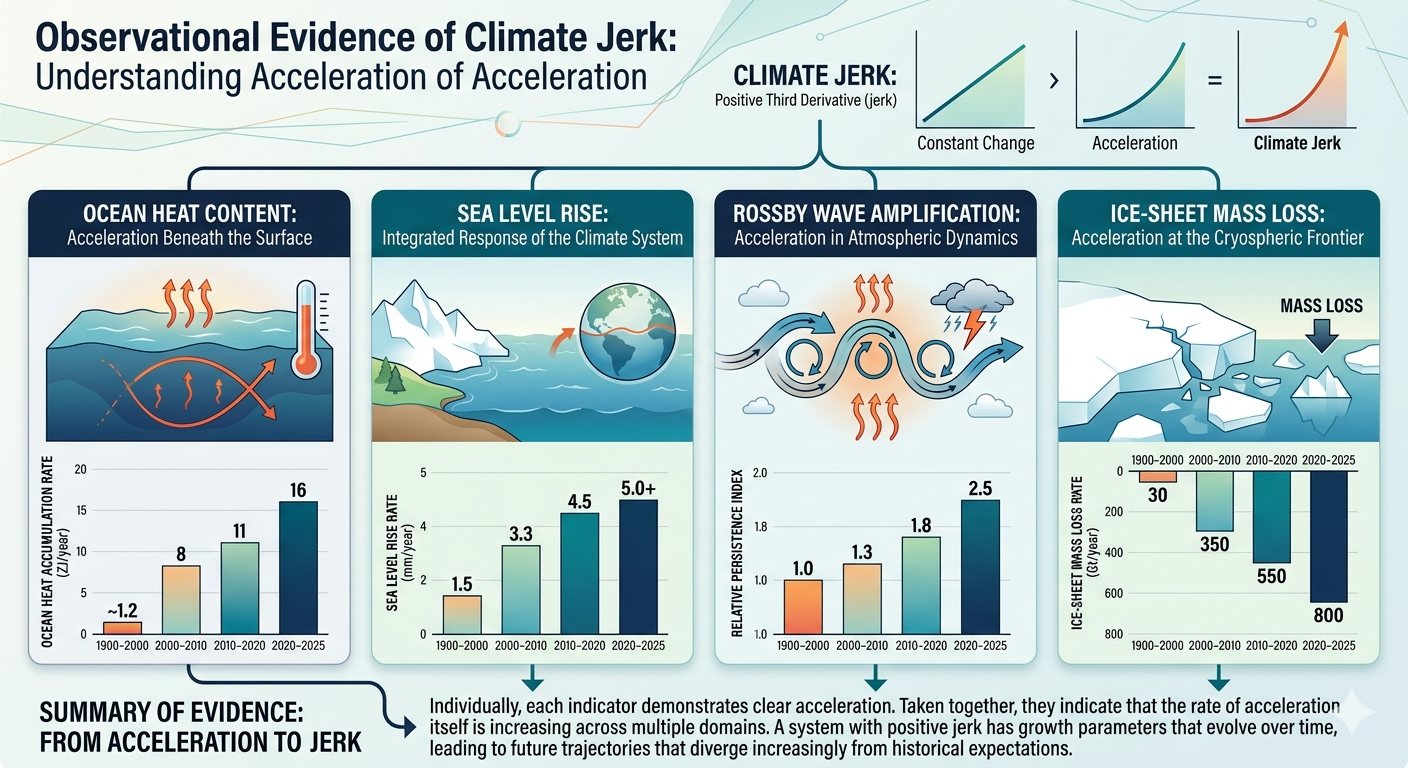
Our latest analysis suggests that the climate–economic system is now exhibiting third-derivative behavior, indicating that not only are impacts increasing, and accelerating, but the acceleration itself is increasing. This places the system within a singularity-like regime, characterized by nonlinear amplification, rising instability, and reduced predictability.
Historically, such transitions were assumed to unfold over tens of thousands to millions of years based on paleoclimate evidence. However, current observations indicate that these dynamics may be occurring on dramatically compressed timescales, raising the possibility that singularity-like behavior could emerge within contemporary time horizons.
Given the importance and accessibility of these findings, this work is presented in three formats:
- Singularity: Public Access Version (6th-grade level)
- Singularity: Easy Version (~8th–10th grade level)
- Singularity: Journal-Ready Version (~college graduate level)
Each version conveys the same core insight: complex, coupled systems can shift rapidly from stable to unstable behavior, and understanding this transition is critical to anticipating future climate and economic risk.
Approaching Singularity: Third Derivatives, Nonlinear Collapse, and Coupled Climate–Economic Instability
(~college graduate level)
Daniel Brouse¹ and Sidd Mukherjee²
March 2026
¹Independent Climate Researcher, Economist
²Physicist
Abstract
A singularity in physics describes a regime in which governing equations break down, often producing non-physical or undefined results such as infinities. While true singularities are rare in real-world systems, many complex systems exhibit singularity-like behavior as they approach critical thresholds characterized by nonlinear amplification, loss of stability, and breakdown of predictability.
This paper develops a unified framework linking physical singularities to real-world system collapse through two analogs: dam failure and vortex dynamics. These systems demonstrate how gradual forcing can produce hidden instability, followed by abrupt, nonlinear transition. We extend this framework to the coupled climate–economic system, presenting evidence that both domains are exhibiting third-derivative behavior (d³I/dt³ > 0), indicating accelerating acceleration. We argue that this dynamic is consistent with systems approaching singularity-like regimes, where small perturbations can trigger large-scale, system-wide responses.
1. Introduction: Singularity as a Boundary of Predictability
In physics, a singularity represents a point at which known laws cease to produce meaningful predictions. Mathematically, this often appears as divergence toward infinity or undefined behavior.
In real-world systems, singularities rarely manifest as literal infinities. Instead, they represent boundaries of model validity, where:
- linear assumptions fail
- system sensitivity increases dramatically
- behavior becomes nonlinear, unstable, and difficult to predict
This paper interprets singularity not as a point, but as a transition regime—a shift from stable, predictable dynamics to chaotic, self-reinforcing behavior.
Singularity marks the boundary of predictability—the edge of what can be reliably observed, modeled, and understood.
2. Dam Collapse: A Physical Analogy of Singularity
2.1 Gradual Forcing and Hidden Instability
A dam subjected to rising water levels exhibits initially stable behavior:
- water level increases
- structural stress accumulates
- micro-fractures develop internally
Despite increasing internal stress, the system appears stable. This reflects latent instability, where damage accumulates without immediate failure.
This process is directly analogous to climate dynamics:
- rising global temperatures
- increasing ocean heat content
- accumulation of greenhouse gases
2.2 Nonlinear Threshold Behavior
Structural stress does not scale linearly with forcing. Instead:
Stress ∝ h
Force ∝ h²
where h is water height.
As a result, small increases in forcing produce disproportionately large increases in stress. Failure risk becomes a nonlinear function of accumulated strain.
2.3 Critical Threshold and Collapse
At a critical point:
- the dam remains intact
- but internal stability is effectively exhausted
At this stage:
A small perturbation → catastrophic failure
This transition exhibits singularity-like behavior:
- system response becomes disproportionate to input
- predictability collapses
- linear models fail
2.4 Runaway Dynamics and Feedback
Once failure begins:
- crack propagation accelerates
- water flow increases
- erosion intensifies
- structural resistance collapses
This creates a positive feedback loop:
More flow → more erosion → larger breach → more flow
Formally:
d²I/dt² > 0
d³I/dt³ > 0
2.5 Functional Singularity
Although no true infinity occurs, the system undergoes a discontinuous transition:
Stable → Unstable → Collapse
This represents a functional singularity—a point where system behavior changes abruptly and irreversibly.
3. Vortex Dynamics: Singular Behavior in Fluid Systems
3.1 Energy Input and Self-Organization
Vortices emerge from energy input into a fluid system:
- pressure gradients develop
- rotational motion forms
- angular momentum is conserved
The system organizes into a coherent structure.
3.2 Nonlinear Acceleration Toward the Core
A defining vortex property is:
v ∝ 1 / r
As radius decreases:
r → 0 ⇒ v → ∞
This represents a mathematical singularity.
3.3 Breakdown of Physical Validity
In reality, infinite velocity does not occur. Instead:
lim (r → 0) v(r) → undefined
This signals:
- breakdown of governing equations
- transition beyond laminar flow assumptions
3.4 Transition to Turbulence
As the vortex intensifies:
- turbulence develops
- instabilities emerge
- dissipation increases
- structure degrades
Thus:
Singularity → Turbulence → Instability
3.5 Feedback Amplification
Vortices are governed by reinforcing dynamics:
Faster rotation → lower pressure → stronger inflow → faster rotation
Which corresponds to:
dv/dt > 0
d²v/dt² > 0
d³v/dt³ > 0
3.6 Singular Behavior Without Infinity
The vortex demonstrates that singularities represent:
- extreme sensitivity to small changes
- rapid nonlinear amplification
- breakdown of predictability
Formally:
|dv/dr| → ∞ as r → 0
4. Observational Evidence of Climate Jerk
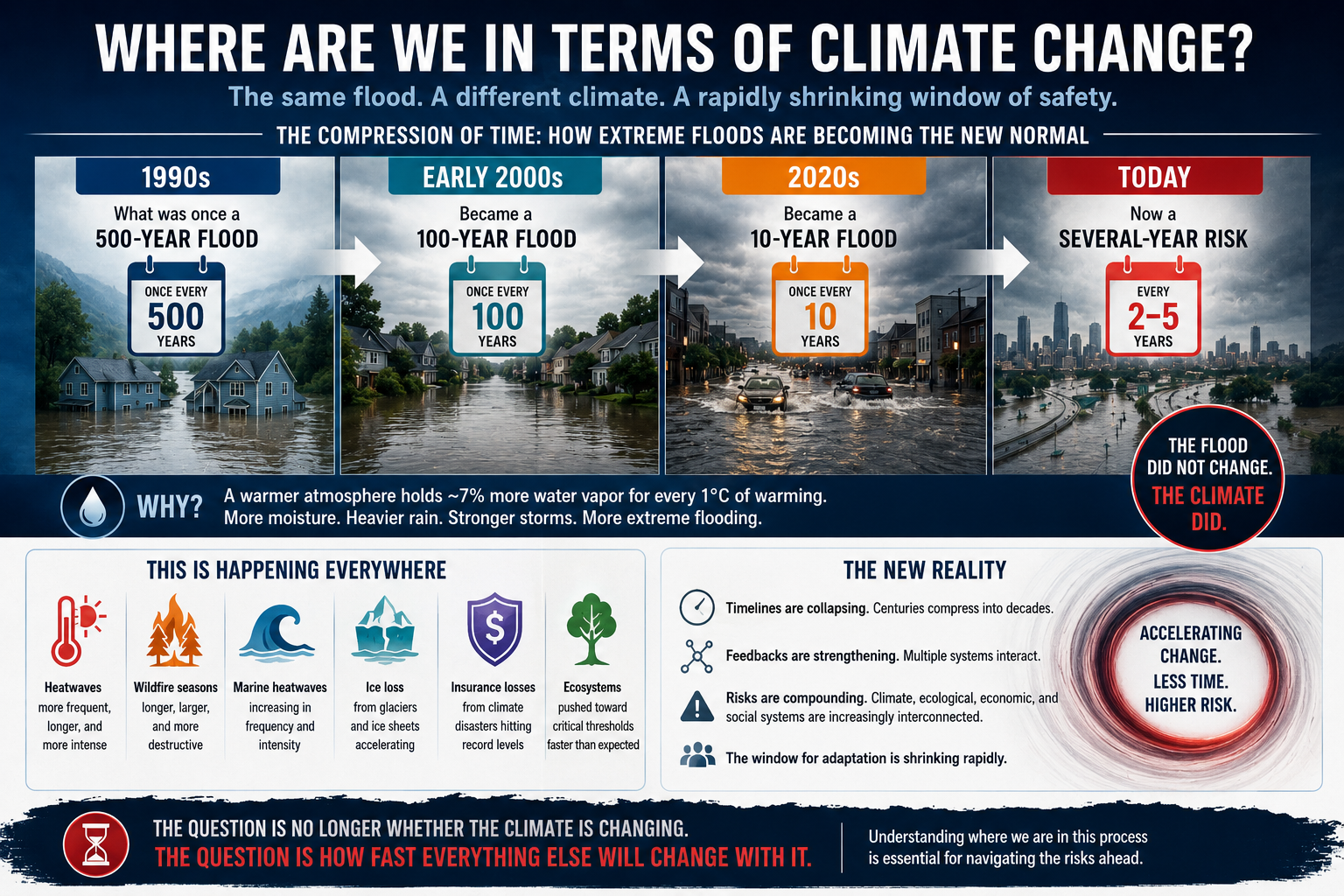
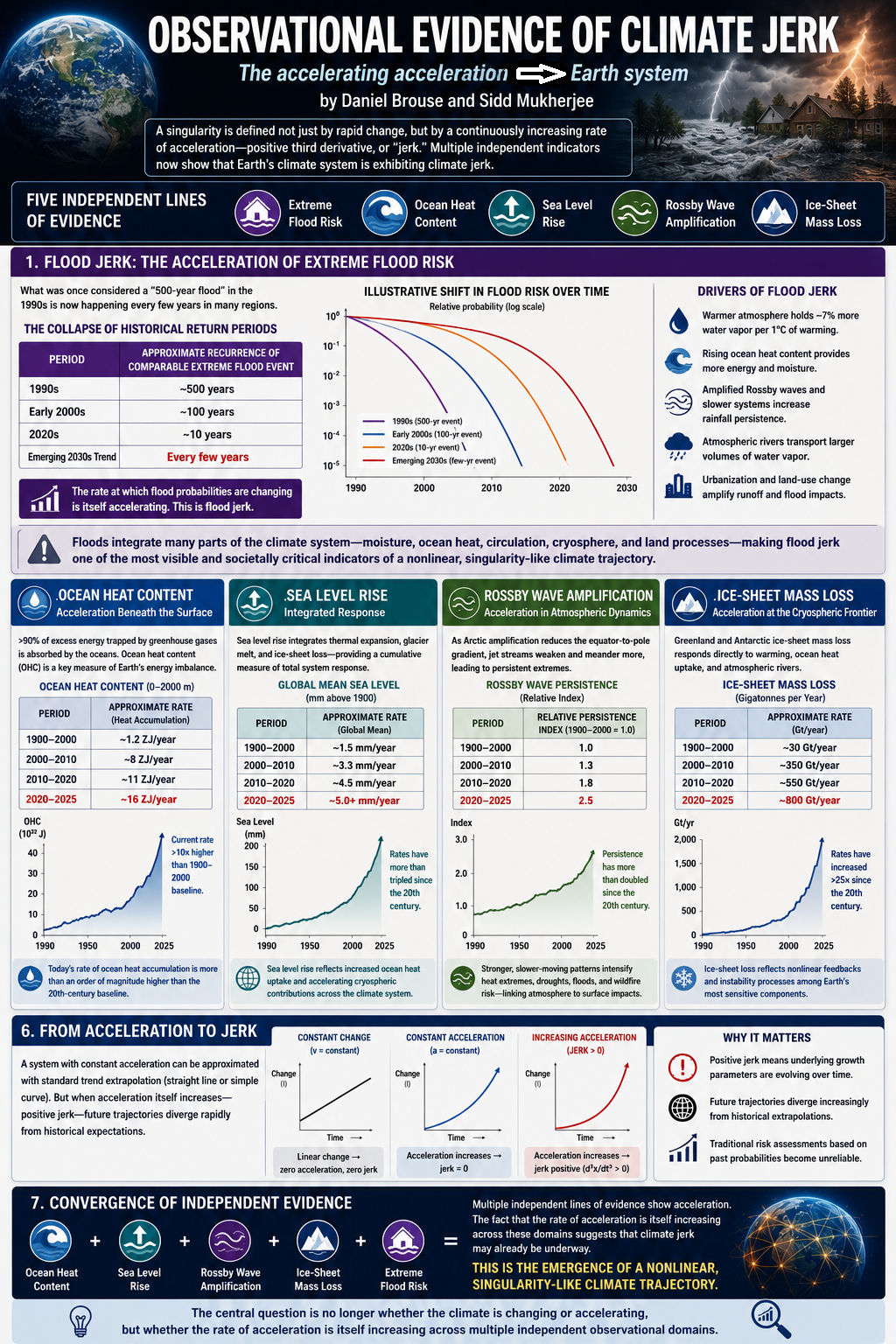
The defining characteristic of a singularity is not merely rapid change, but a continuously increasing rate of acceleration. In mathematical terms, the system exhibits a positive third derivative—commonly referred to as "jerk." While global surface temperature remains the most widely cited climate metric, several other indicators provide clearer evidence that the Earth system is increasingly characterized not simply by change or acceleration, but by acceleration of acceleration.
Among the strongest candidates are extreme flood risk, ocean heat content, sea level rise, Rossby wave amplification, and ice-sheet mass loss.
Ocean Heat Content: Acceleration Beneath the Surface
More than 90% of the excess energy trapped by greenhouse gases is absorbed by the oceans. As a result, ocean heat content (OHC) provides one of the most reliable measures of Earth’s energy imbalance.
Estimated rates of heat accumulation have increased significantly:
| Period | Approximate Rate |
|---|---|
| 1900–2000 | ~1.2 ZJ/year |
| 2000–2010 | ~8 ZJ/year |
| 2010–2020 | ~11 ZJ/year |
| 2020–2025 | ~16 ZJ/year |
Relative to the 20th-century baseline, the current rate of ocean heat accumulation is more than an order of magnitude higher. This makes ocean heat content one of the clearest physical indicators of accelerating planetary energy imbalance.
Sea Level Rise: Integrated Response of the Climate System
Global mean sea level rise integrates multiple processes including thermal expansion of seawater, glacier melt, and ice-sheet mass loss. As such, it functions as a cumulative indicator of total system response to energy imbalance.
Estimated rates of sea level rise have increased over time:
| Period | Approximate Rate |
|---|---|
| 1900–2000 | ~1.5 mm/year |
| 2000–2010 | ~3.3 mm/year |
| 2010–2020 | ~4.5 mm/year |
| 2020–2025 | ~5.0+ mm/year |
The transition from relatively modest 20th-century rates to significantly higher modern rates reflects both increased ocean heat uptake and accelerating cryospheric contributions. Because sea level rise integrates multiple subsystems, it provides a key “system-level” measure of climate acceleration.
Rossby Wave Amplification: Acceleration in Atmospheric Dynamics
Rossby waves regulate the large-scale structure of atmospheric circulation. Their amplitude, persistence, and phase behavior influence heat waves, droughts, atmospheric rivers, and persistent blocking events.
As Arctic amplification reduces the equator-to-pole temperature gradient, jet stream flow weakens and becomes more susceptible to high-amplitude meanders. This contributes to increasingly persistent weather extremes.
| Period | Relative Persistence Index |
|---|---|
| 1900–2000 | 1.0 |
| 2000–2010 | 1.3 |
| 2010–2020 | 1.8 |
| 2020–2025 | 2.5 |
Rossby wave amplification is particularly important because it functions as a coupling mechanism between atmospheric dynamics and surface impacts. Persistent circulation patterns intensify heat extremes, drought persistence, flood clustering, and wildfire risk, thereby linking atmospheric behavior to surface system responses.
Ice-Sheet Mass Loss: Acceleration at the Cryospheric Frontier
Ice-sheet mass loss from Greenland and Antarctica represents one of the most direct responses to increasing radiative forcing and ocean heat uptake.
| Period | Approximate Rate |
|---|---|
| 1900–2000 | ~30 Gt/year |
| 2000–2010 | ~350 Gt/year |
| 2010–2020 | ~550 Gt/year |
| 2020–2025 | ~800 Gt/year |
The increase in ice-sheet mass loss reflects the combined effects of surface melt, ice-ocean interactions, atmospheric river intrusion, and structural instability in outlet glaciers. These interacting processes produce strong nonlinear feedback behavior and make ice sheets one of the most sensitive components of the Earth system.
From Acceleration to Jerk
Individually, ocean heat content, sea level rise, Rossby wave amplification, and ice-sheet mass loss each demonstrate clear acceleration. Taken together, they indicate something more significant: the acceleration itself is increasing.
This distinction is critical. A system with constant acceleration can often be approximated using standard trend extrapolation. A system with positive jerk cannot. In such a system, the underlying growth parameters evolve over time, and future trajectories diverge increasingly from historical expectations.
In this framework, the emergence of climate jerk represents a potential indicator that the Earth system is transitioning toward a regime dominated by nonlinear feedbacks and interacting subsystems. The central question is therefore no longer whether the climate is changing or accelerating, but whether the rate of acceleration is itself increasing across multiple independent observational domains.
The convergence of ocean heat content, sea level rise, atmospheric circulation changes, and ice-sheet mass loss suggests that this condition may already be underway.
5. Climate and Economic Singularity
The climate system and the global economy form a coupled nonlinear system characterized by reinforcing feedback loops. Increasing evidence suggests both systems are exhibiting third-derivative behavior:
dI/dt > 0
d²I/dt² > 0
d³I/dt³ > 0
This indicates:
- impacts are increasing
- acceleration is increasing
- acceleration itself is increasing
5.1 Coupled Feedback Dynamics
The interaction between climate and economic systems can be expressed as:
Increasing climate impacts → rising economic losses → reduced adaptive capacity → increased vulnerability → further impacts
This creates a self-reinforcing feedback loop.
5.2 Mechanisms of Nonlinear Amplification
Climate system drivers include:
- ice-albedo feedback
- ocean heat accumulation
- atmospheric moisture amplification
- ecosystem degradation
Economic responses include:
- rising disaster losses
- infrastructure stress
- insurance market withdrawal
- capital mispricing
- sovereign fiscal pressure
5.3 Singularity-Like Regime
As feedbacks intensify, both systems approach a regime characterized by:
- extreme sensitivity to small perturbations
- dominance of feedback loops
- breakdown of predictive models
- increasing probability of abrupt transitions
This defines singularity-like behavior.
5.4 Phase Transition Dynamics
Collapse should not be viewed as a single event, but as a phase transition:
Stable → Nonlinear → Chaotic
In this regime:
- volatility increases
- system coherence degrades
- cascading failures become more likely
6. Synthesis: From Physical Systems to Climate Risk
Both dam collapse and vortex dynamics demonstrate a common principle:
Singularity ≠ infinity
Singularity = breakdown of stability and predictability
Across systems:
| Physical System | Behavior Near Singularity |
|---|---|
| Dam | Structural collapse |
| Vortex | Turbulence |
| Climate | Cascading instability |
| Economy | Systemic financial stress |
7. Conclusion
This analysis demonstrates that singularity-like behavior is a defining feature of nonlinear systems approaching instability. Both physical analogs—dam failure and vortex dynamics—illustrate how gradual forcing can lead to abrupt, disproportionate outcomes through feedback amplification.
The coupled climate–economic system now exhibits similar characteristics, including positive third-derivative behavior (d³I/dt³ > 0), indicating accelerating acceleration. This dynamic suggests that the system is entering a regime where:
- small perturbations can produce large-scale impacts
- predictability is increasingly limited
- nonlinear feedbacks dominate system behavior
Importantly, the concept of singularity in this context does not imply infinite outcomes, but rather a transition beyond the limits of conventional modeling and incremental adaptation. If current trends persist, the probability of rapid, system-wide disruption will continue to increase—not as a distant possibility, but as an emergent property of the system itself.
Singularity represents the boundary of understanding. As systems approach and cross this boundary, the risk of cascading failures increases nonlinearly over time, making large-scale disruption increasingly likely even in response to relatively small perturbations.
Easy-to-Read References
-
Singularity: The Runaway Guitar Feedback Scenario
Definitions of: runaway climate indicator feedbacks, runaway greenhouse effect, Hothouse Earth, Venus Syndrome, and singularity - The Runaway Train Scenario
- Example: Amazon Rainforest Dieback
References
IPCC (2023). Sixth Assessment Report
Lenton, T. et al. (2019). Climate tipping points
Hansen, J. et al. (2016). Ice melt and sea level rise
NOAA National Centers for Environmental Information. Billion-Dollar Weather and Climate Disasters Database
- The Compression of Doubling Times Across Earth-System Indicators: Evidence for Increasing Nonlinearity in the Climate System -- Brouse and Mukherjee (June 2026)
- Observational Evidence for Climate Jerk: Multidisciplinary Indicators of Accelerating Climate Acceleration -- Brouse and Mukherjee (June 2026)
- A Unified Energetics Framework for Accelerating Climate Change: From Radiative Forcing to Drag Physics — Brouse and Mukherjee (March 2026)
- Emergent Climate Dynamics: The Nonlinear Acceleration of Climate Impacts — Brouse and Mukherjee (March 2026)
- The Third Derivative and Climate Acceleration: Why Change Is Increasing Faster Over Time — Brouse (March 2026)
- Case Study: Climate Coupling and Hidden Economic Costs — Brouse (March 2026)
- How Not to Be a Jerk: Third Derivatives and the Singularity of Climate Change — Brouse and Mukherjee (March 2026)
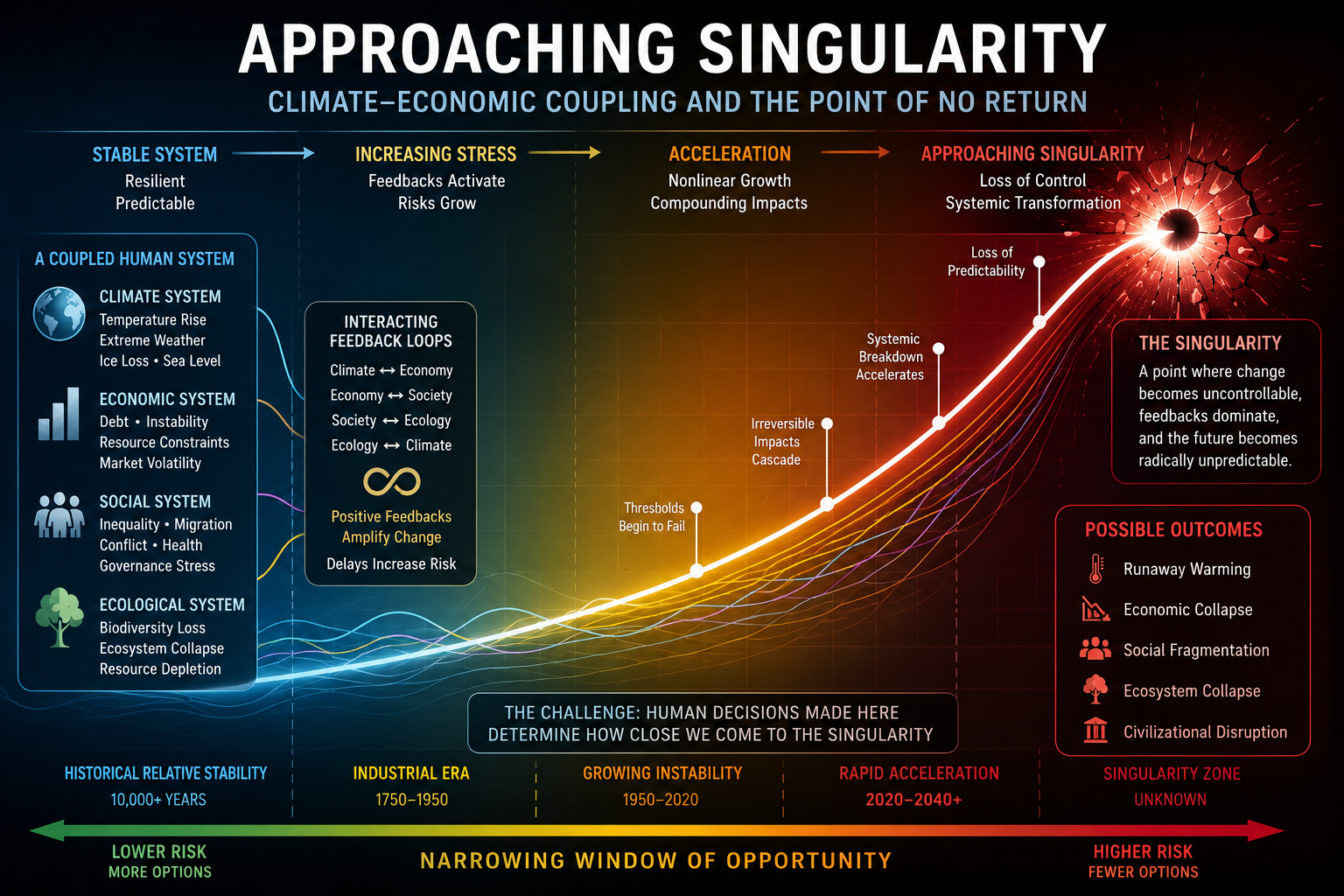
* Our probabilistic, ensemble-based climate model — which incorporates complex socio-economic and ecological feedback loops within a dynamic, nonlinear system — projects that global temperatures are becoming unsustainable this century. This far exceeds earlier estimates of a 4°C rise over the next thousand years, highlighting a dramatic acceleration in global warming. We are now entering a phase of compound, cascading collapse, where climate, ecological, and societal systems destabilize through interlinked, self-reinforcing feedback loops.
Tipping points and feedback loops drive the acceleration of climate change. When one tipping point is toppled and triggers others, the cascading collapse is known as the Domino Effect.
Further References
Primary Sources
Brouse, D., & Mukherjee, S. (2026). 2026: Observational Evidence of Climate Jerk: Ocean Heat Content, Sea Level Rise, Rossby Wave Amplification, and Ice-Sheet Mass Loss. Membrane.com Climate Science Series. Retrieved from http://membrane.com/global_warming/Jerk-Climate-Evidence.html
Brouse, D., & Mukherjee, S. (2026). 2026: Confirmation of Nonlinear Climate Acceleration in the Arctic–North Atlantic System. Membrane.com Climate Science Series. Retrieved from http://membrane.com/global_warming/Nonlinear-Climate-Acceleration.html
Brouse, D., & Mukherjee, S. (2026). Amazon Rainforest Dieback: Emerging Risks, Feedback Loops, and Scenario-Based Projections. Membrane.com Climate Science Series. Retrieved from http://membrane.com/global_warming/Amazon-Dieback.html
Brouse, D., & Mukherjee, S. (2026). A Unified Energetics Framework for Accelerating Climate Change: From Radiative Forcing to Drag Physics. Membrane.com Climate Science Series. Retrieved from http://membrane.com/global_warming/Climate-Change-Math-and-Physics.html
Brouse, D., & Mukherjee, S. (2026). Is Climate Change on a Runaway Train?. Membrane.com Climate Science Series. Retrieved from http://membrane.com/global_warming/Climate-Runaway-Train-Scenario.html
Hansen and Colleagues
Hansen, J. E. (2025). Runaway Climate: The Point of No Return. Climate Science, Awareness and Action Newsletter. Retrieved from https://mailchi.mp/caa/runaway-climate-the-point-of-no-return
Hansen, J. E., Kharecha, P., Morgan, P., et al. (2025). Global Warming Acceleration: Impact on Sea Ice. Retrieved from http://membrane.com/global_warming/notes/SeaIce-Acceleration-02April2025.pdf
Hansen, J. E., Kharecha, P., & Morgan, P. (2025). Warning! This "Colorful Chart" is Censored by IPCC. Retrieved from http://membrane.com/global_warming/notes/Hansen-Acceleration-2025.pdf
Peer-Reviewed Literature
Baldwin, M. P., et al. (2021). Climate system variability and atmospheric circulation changes. Reviews of Geophysics, 59(1).
Caesar, L., McCarthy, G. D., Thornalley, D. J. R., Cahill, N., & Rahmstorf, S. (2021). Current Atlantic Meridional Overturning Circulation weakest in the last millennium. Nature Geoscience, 14, 118–120.
Francis, J. A., & Vavrus, S. J. (2012). Evidence linking Arctic amplification to extreme weather in mid-latitudes. Geophysical Research Letters, 39(6).
IMBIE Team. (2020). Mass balance of the Greenland Ice Sheet from 1992–2018. Nature, 579, 233–239.
Khan, S. A., Aschwanden, A., Bjørk, A. A., et al. (2016). Greenland ice sheet mass balance and sea-level contribution. Science Advances, 2(11), e1600931.
Mann, M. E., Rahmstorf, S., Kornhuber, K., et al. (2017). Influence of anthropogenic climate change on planetary wave resonance and extreme weather events. Scientific Reports, 7, 45242.
Overland, J. E., Hanna, E., Hanssen-Bauer, I., et al. (2019). The urgency of Arctic climate change. Nature Climate Change, 9, 181–184.
Serreze, M. C., & Barry, R. G. (2011). Processes and impacts of Arctic amplification. Global and Planetary Change, 77(1–2), 85–96.
Svennevig, K., et al. (2023). Climate-driven slope failures and cryosphere destabilization in Greenland. Geophysical Research Letters, 50.
Major Assessments and Data Sources
IPCC. (2021). Climate Change 2021: The Physical Science Basis. Contribution of Working Group I to the Sixth Assessment Report. Cambridge University Press.
NASA. (2025). Global Mean Sea Level from Satellite Altimetry. National Aeronautics and Space Administration. Retrieved from https://sealevel.nasa.gov
National Oceanic and Atmospheric Administration (NOAA). (2025). Climate Indicators and Global Monitoring Data. Retrieved from https://www.noaa.gov
World Meteorological Organization (WMO). (2024). State of the Global Climate 2024. Geneva, Switzerland.
Copernicus Climate Change Service (C3S). (2025). Global Climate Highlights. European Union.
Additional Recent Literature Relevant to Nonlinear Climate Dynamics
Armstrong McKay, D. I., Staal, A., Abrams, J. F., et al. (2022). Exceeding 1.5°C global warming could trigger multiple climate tipping points. Science, 377(6611), eabn7950.
Boers, N. (2021). Observation-based early-warning signals for a collapse of the Atlantic Meridional Overturning Circulation. Nature Climate Change, 11, 680–688.
Lenton, T. M., Rockström, J., Gaffney, O., et al. (2019). Climate tipping points—too risky to bet against. Nature, 575, 592–595.
Ripple, W. J., Wolf, C., Gregg, J. W., et al. (2024). The 2024 State of the Climate Report: Perilous Times on Planet Earth. BioScience.
Steffen, W., Rockström, J., Richardson, K., et al. (2018). Trajectories of the Earth System in the Anthropocene. Proceedings of the National Academy of Sciences, 115(33), 8252–8259.
Richardson, K., Steffen, W., Lucht, W., et al. (2023). Earth beyond six of nine planetary boundaries. Science Advances, 9(37), eadh2458.