Climate Change Tipping Points
The Domino Effect
Warming → Feedback Activation → Feedback Coupling → Amplification → Tipping-Point Threshold → CascadeThe climate system is not simply warming—it is changing how it responds to that warming. Coupled climate feedbacks are becoming one of the most consequential dimensions of climate risk in the 21st century because they amplify changes and connect individual tipping-point pathways into larger cascading effects.
The low-level cloud feedback could contribute an additional 1.5°C to 2°C of global warming. In a tipping point scenario where clouds completely break up under extreme emission tracks, it could trigger a catastrophic, abrupt warming spike.
The longer warming persists, the more climate feedbacks become active. As these feedbacks interact, we are already observing nonlinear responses, amplification, and cascading impacts across the climate system. Hundreds of feedback mechanisms have been identified, and many can couple and reinforce one another, contributing to the accelerating pace and increasing magnitude of climate change—The Domino Effect.
Daniel Brouse¹ and Sidd Mukherjee²
September 2022 – August 2023 (Updated June 2026)
¹Independent Climate Researcher, Economist
²Physicist
Introduction: Beyond Linear Climate Change
For decades, climate change was often discussed as a gradual, linear process—a steady increase in temperatures resulting from steadily increasing greenhouse gas concentrations. While greenhouse gases remain the primary driver of warming, our understanding of the climate system has evolved dramatically.
The Earth does not behave like a simple machine. It behaves like a complex adaptive system composed of interconnected oceans, ice sheets, forests, ecosystems, atmospheric circulation patterns, and human societies. These systems interact through feedback loops, nonlinear dynamics, and threshold effects.
As a result, climate change is increasingly understood not as a smooth progression but as a series of potential tipping points capable of triggering abrupt and self-sustaining changes.
The greatest danger is not any single tipping point. It is the possibility that multiple tipping points begin interacting, creating cascading failures throughout the Earth system. Once these feedbacks become dominant, climate change can accelerate independently of the human emissions that initially triggered it.
Understanding these tipping points is therefore essential to understanding the risks humanity faces during the twenty-first century.
Understanding Tipping Points
Feedback loops and tipping points interact, couple, and influence one another within a complex, interconnected system. They do not operate in a simple linear sequence. However, tracing a chain reaction from the North Pole toward the equator provides a useful illustration of how changes in one part of the climate system can propagate through, amplify, and trigger responses across the planet.
This is what is happening right now. And with every reinforcing feedback we activate, we amplify what comes next.
Polar amplification → weakened equator-to-pole temperature gradients → reduced thermal contrast → atmospheric circulation changes → accelerated Arctic and Greenland ice melt → ICE–ALBEDO FEEDBACK: ice loss → darker surface → greater solar absorption → more warming → more ice loss ↺ → MELT–ELEVATION FEEDBACK: ice loss → lower ice-sheet elevation → warmer air → faster surface melt → further elevation loss ↺ → LAPSE-RATE FEEDBACK: Arctic warming → weaker vertical temperature gradient → reduced atmospheric cooling efficiency → additional near-surface warming → more ice melt ↺ → coupled cryospheric amplification → freshwater input into the North Atlantic → reduced salinity + density → AMOC disruption / potential weakening → North Atlantic pressure-field + storm-track reorganization → greater jet-stream waviness → slower progression → amplified Rossby waves → persistent blocking + omega blocks + meridional flow → stalled atmospheric rivers + prolonged heat domes + drought–flood swings → hydroclimatic whiplash → agriculture + infrastructure + ecosystems + public health stress → PERMAFROST TIPPING ELEMENT: thaw → CO₂ + CH₄ release → additional greenhouse forcing → Arctic warming ↺ → BOREAL FOREST TIPPING ELEMENT: warming + drought + wildfire → forest degradation → reduced carbon uptake + carbon release → additional warming ↺ → AMAZON RAINFOREST TIPPING ELEMENT: warming + drought + fire → reduced evapotranspiration + rainfall recycling → greater drought → forest loss + carbon release → additional warming ↺ → WEST ANTARCTIC ICE-SHEET TIPPING ELEMENT: ice instability → accelerated ice loss → sea-level rise → additional cryospheric stress → global land-ice loss + groundwater redistribution → planetary mass redistribution → altered moment of inertia → rotational dynamics → slight rotational slowing → changes in length of day.
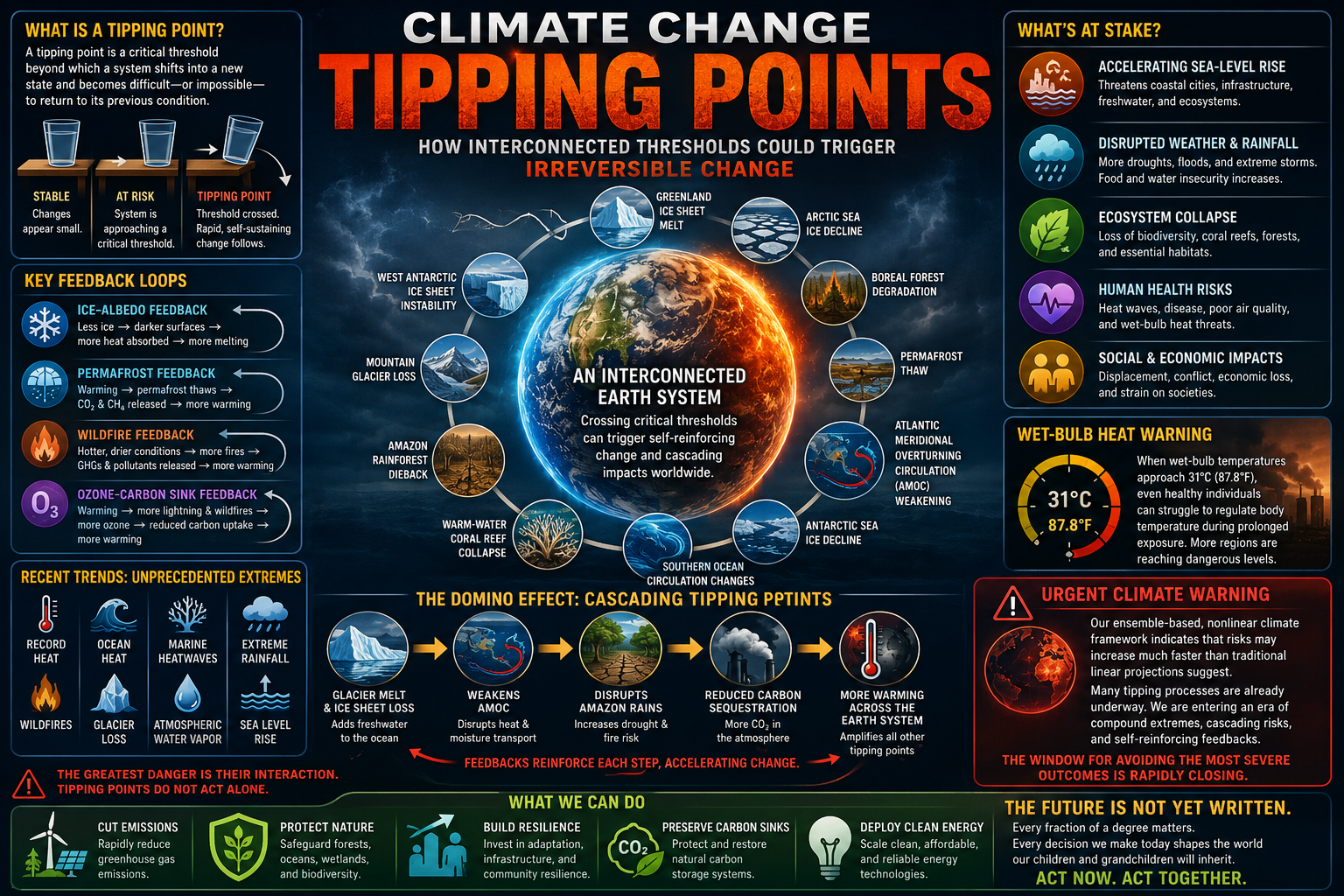
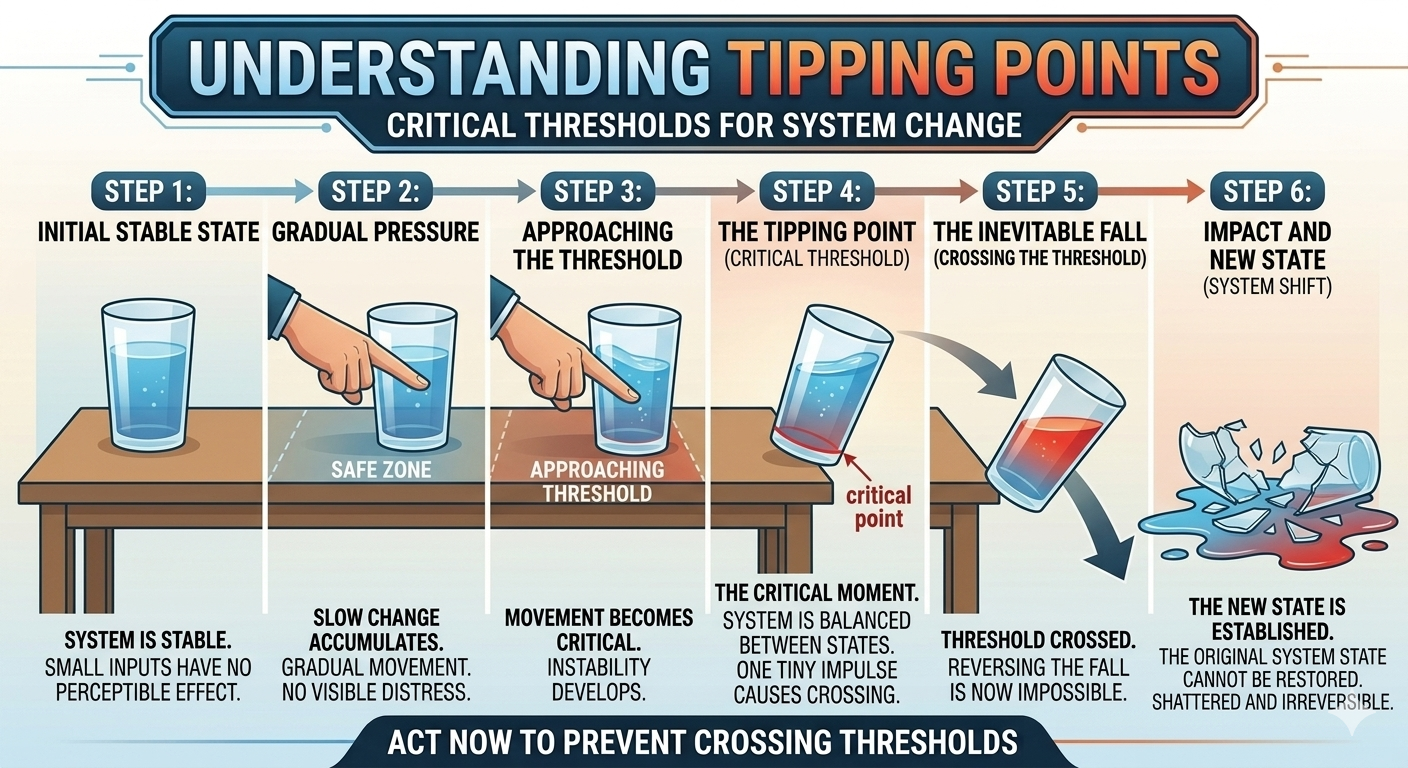
A tipping point is a critical threshold beyond which a system shifts into a new state and becomes difficult—or impossible—to return to its previous condition.
Imagine slowly pushing a glass toward the edge of a table. For a time, nothing dramatic happens. Then the glass reaches a critical point and falls. Once that threshold is crossed, the outcome becomes largely inevitable.
Climate tipping points operate in much the same way.
For years, environmental changes may appear gradual. Then a critical threshold is crossed, and rapid change follows. These transitions can unfold over years, decades, or centuries, but once initiated they often become self-reinforcing.
Climate tipping points are not political opinions or theoretical possibilities. They are physical thresholds governed by the laws of physics, chemistry, ecology, and thermodynamics.
What Are Climate Tipping Points?
Climate tipping points are thresholds within Earth's climate system beyond which change becomes self-sustaining.
Once activated, these processes can continue even if human emissions are reduced, pushing portions of the Earth system into new and potentially irreversible states.
Many of these tipping elements are already showing signs of destabilization.
Methane released from thawing permafrost cannot simply be returned underground.
Mountain glaciers that accumulated over thousands of years are disappearing within decades.
Coral reef ecosystems are collapsing under increasing thermal stress.
The Arctic is warming nearly four times faster than the global average.
The consequences extend far beyond the regions where these changes originate. As warming accelerates, formerly stable carbon sinks can become carbon sources, amplifying the warming that triggered them.
This is the defining characteristic of a positive feedback loop: warming causes change, and that change causes additional warming.
Evidence of Crossed and Emerging Tipping Points
In 2019, Professor Tim Lenton warned:
“A decade ago we identified a suite of potential tipping points in the Earth system. Now we see evidence that over half of them have been activated. It is no longer responsible to wait and see.”
Since then, scientific evidence has continued to accumulate.
Several major tipping elements are now considered active, destabilizing, or approaching critical thresholds:
- Greenland Ice Sheet melt
- West Antarctic Ice Sheet instability
- Mountain glacier loss
- Arctic sea ice decline
- Permafrost thaw
- Boreal forest degradation
- Amazon rainforest dieback
- Warm-water coral reef collapse
- Atlantic Meridional Overturning Circulation (AMOC) weakening
- Antarctic sea ice decline
- Southern Ocean circulation changes
Increasingly, researchers are focusing not merely on individual tipping points but on the interactions among them.
Fastest-Moving Tipping Systems
Coral Reef Die-Offs
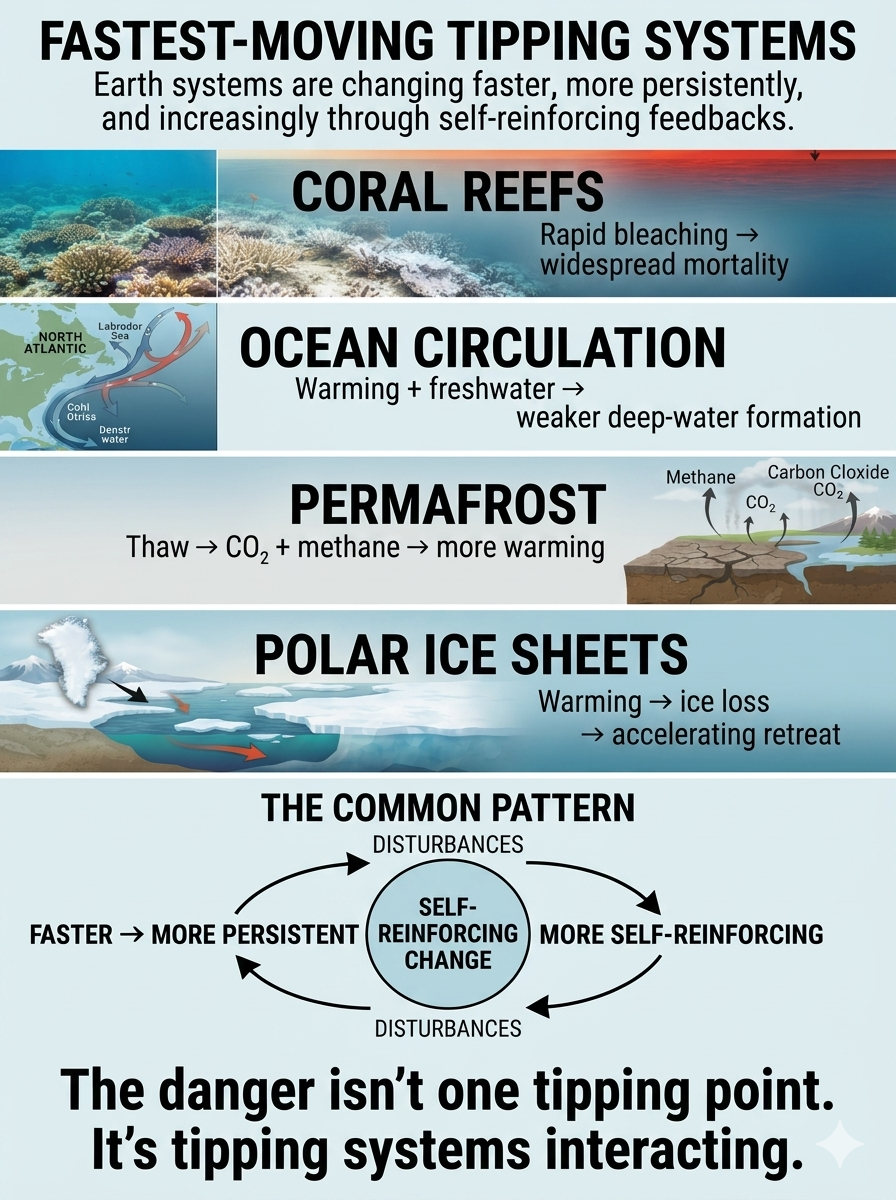
Warm-water coral reef dieback is widely recognized as one of the clearest examples of an Earth-system tipping point now being actively crossed—and among the major ecological tipping systems, it is showing some of the fastest rates of deterioration. Driven by record-breaking marine heatwaves associated with global temperatures approaching 1.4°C above pre-industrial levels, widespread coral mortality is unfolding across the world’s tropical oceans. The scale and speed of reef degradation are exceeding many earlier projections.
Repeated mass-bleaching events are causing widespread coral mortality and ecological degradation. As heat stress becomes more frequent and severe, many reefs are losing their ability to recover between bleaching events, making warm-water coral ecosystems one of the fastest-collapsing major ecological systems on Earth.
Subpolar Ocean Circulation
Deep-water formation in the Labrador Sea and North Atlantic is showing signs of increasing instability as warming and freshwater influx from melting ice alter ocean density and circulation. Continued weakening could disrupt regional and global climate patterns.
Permafrost Thaw
Arctic permafrost is degrading as temperatures rise, releasing carbon dioxide and methane that have accumulated in frozen soils over thousands of years. Accelerating thaw creates a potentially self-reinforcing feedback: warming increases permafrost loss, which releases additional greenhouse gases and contributes to further warming.
Polar Ice Sheets
Parts of the Greenland and West Antarctic ice sheets are experiencing accelerating mass loss. As ice sheets retreat, feedbacks involving surface elevation, ocean heat, ice dynamics, and albedo can increase instability and make further ice loss increasingly difficult to reverse.
The Common Pattern
These systems differ in their physical mechanisms, but they share a critical characteristic: change is becoming faster, more persistent, and increasingly self-reinforcing.
The danger is not simply that individual tipping systems may cross thresholds. It is that multiple systems can interact, creating cascading feedbacks that accelerate Earth-system change beyond the rate suggested by any single process alone.
The Amazon Dieback Threat
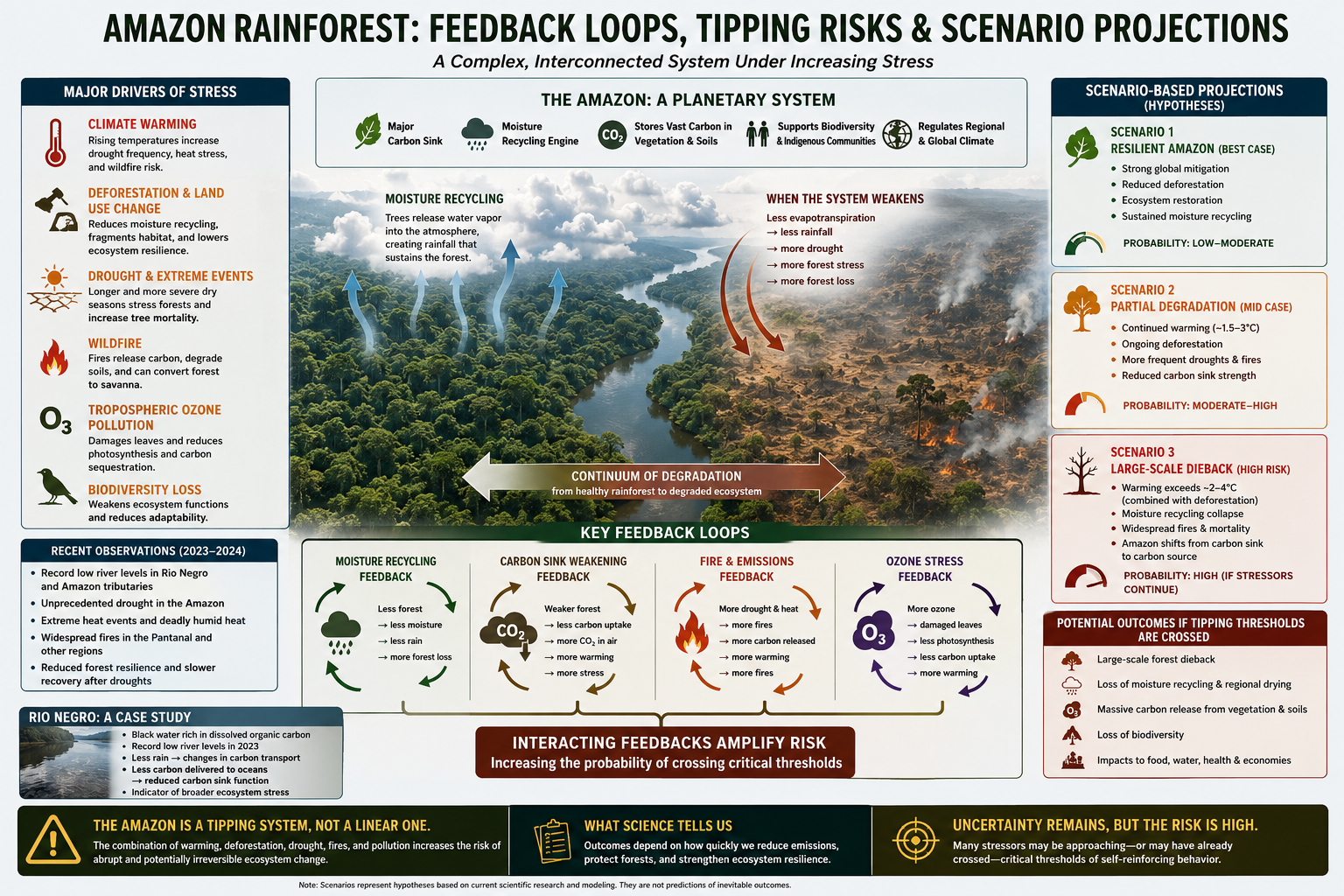
The Amazon rainforest is one of Earth's most important climate stabilizers.
The forest stores hundreds of billions of tons of carbon while generating much of its own rainfall through evapotranspiration. For decades, the Amazon acted as a powerful carbon sink, helping slow the accumulation of greenhouse gases in the atmosphere.
Growing evidence suggests this system is becoming increasingly unstable.
Deforestation, rising temperatures, prolonged droughts, wildfire activity, and changing rainfall patterns are weakening the resilience of the rainforest.
As forest cover declines, less moisture is recycled into the atmosphere. Reduced rainfall increases drought stress. Drought increases wildfire risk and tree mortality. Forest loss then reduces rainfall even further.
This feedback loop can be summarized as:
Deforestation and Warming → Reduced Rainfall → Increased Drought and Fire → Forest Loss → Reduced Rainfall → Additional Forest Loss
Physicist Sidd Mukherjee warned:
“The Amazon could be the first tipping point we see collapse in our lifetimes.”
A large-scale Amazon dieback would have global consequences.
The forest stores an estimated 150–200 billion tons of carbon. A transition from rainforest to savanna-like ecosystems would release large amounts of carbon dioxide while simultaneously eliminating one of Earth's largest natural carbon sinks.
The Amazon is particularly concerning because it sits at the intersection of several climate feedback systems, including AMOC changes, wildfire activity, ozone damage to vegetation, and global carbon cycle disruption.
Antarctica: The Sleeping Giant
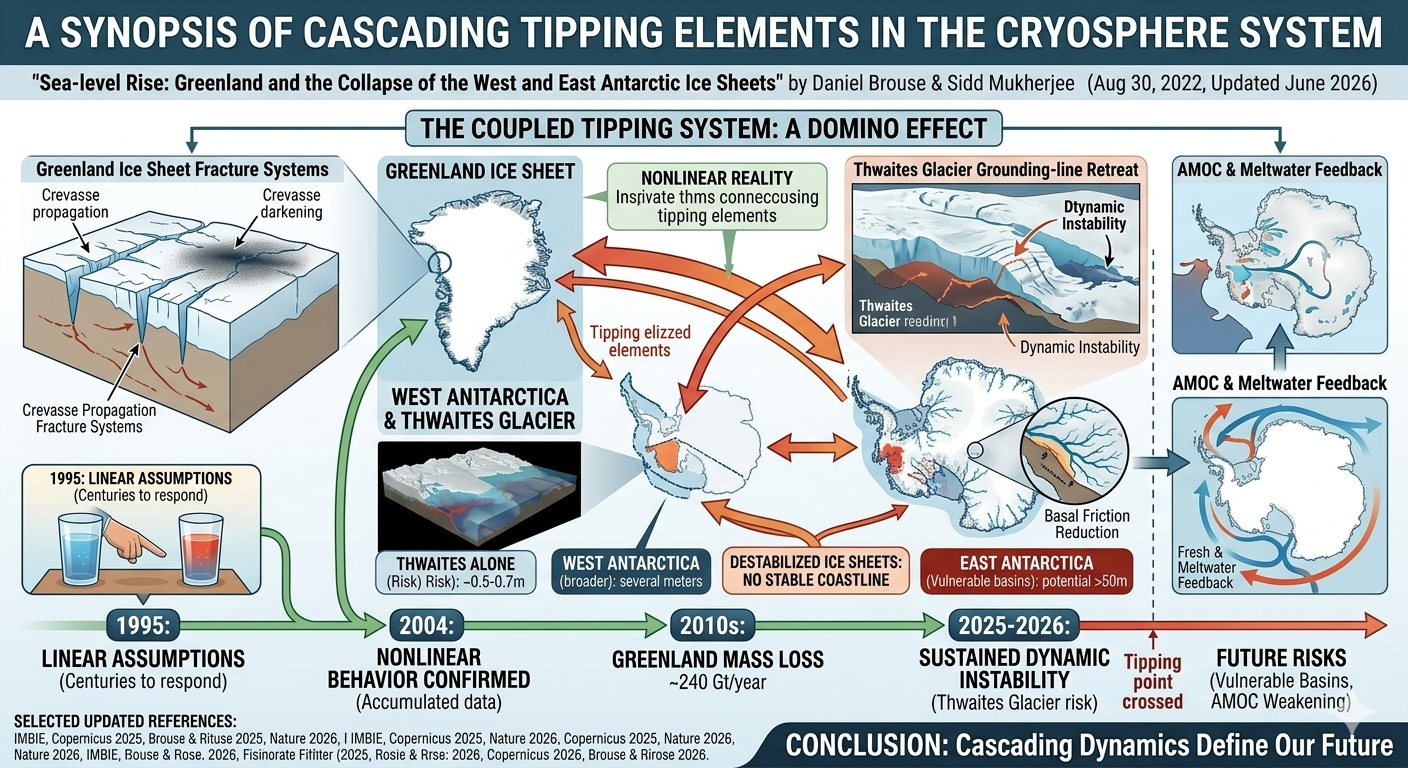
While the Amazon may be the tipping point most visible within our lifetimes, Antarctica may ultimately prove to be the most consequential.
For decades Antarctica was viewed as relatively stable. Recent research is increasingly challenging that assumption.
Scientists now view Antarctica not as a single ice sheet but as a collection of interconnected drainage basins, each possessing its own tipping threshold.
Particularly concerning are the Thwaites and Pine Island glacier systems of West Antarctica.
Much of the ice in these regions rests on bedrock below sea level, making them vulnerable to warm ocean water that can melt glaciers from beneath.
As protective ice shelves thin or collapse, they lose their ability to restrain inland ice. Once this buttressing effect weakens, glaciers can accelerate toward the ocean through a process known as Marine Ice Sheet Instability.
Some studies suggest portions of West Antarctica may already be committed to long-term retreat under current warming conditions.
The implications extend far beyond Antarctica:
- Accelerated global sea-level rise
- Increased coastal flooding
- Disruption of ocean circulation
- Changes in marine ecosystems
- Amplification of climate feedback loops worldwide
Antarctica is increasingly viewed not merely as a victim of climate change but as a potential accelerator of future climate change.
The AMOC Warning
The Atlantic Meridional Overturning Circulation (AMOC) acts as one of the Earth's most important heat-distribution systems.
Recent studies suggest the AMOC may be weakening more rapidly than previously expected.
A significant weakening or collapse could:
- Accelerate sea-level rise along the U.S. East Coast
- Alter rainfall patterns across Europe and Africa
- Increase drought risk in South America
- Shift storm tracks across the Northern Hemisphere
Climate history shows that abrupt AMOC changes have been associated with some of the most dramatic climate transitions observed in the geological record.
Feedback Loops and Cascading Tipping Points
Climate change is not driven by a single feedback mechanism.
It is the result of many interconnected feedback loops operating simultaneously.
Ice-Albedo Feedback
As snow and ice disappear, darker land and ocean surfaces absorb more solar energy.
More absorbed heat causes more melting.
Permafrost Feedback
Warming thaws frozen soils.
Thawing releases carbon dioxide and methane.
These greenhouse gases accelerate warming and further thawing.
Wildfire Feedback
Hotter, drier conditions increase wildfire activity.
Wildfires release greenhouse gases and atmospheric pollutants that contribute to further warming.
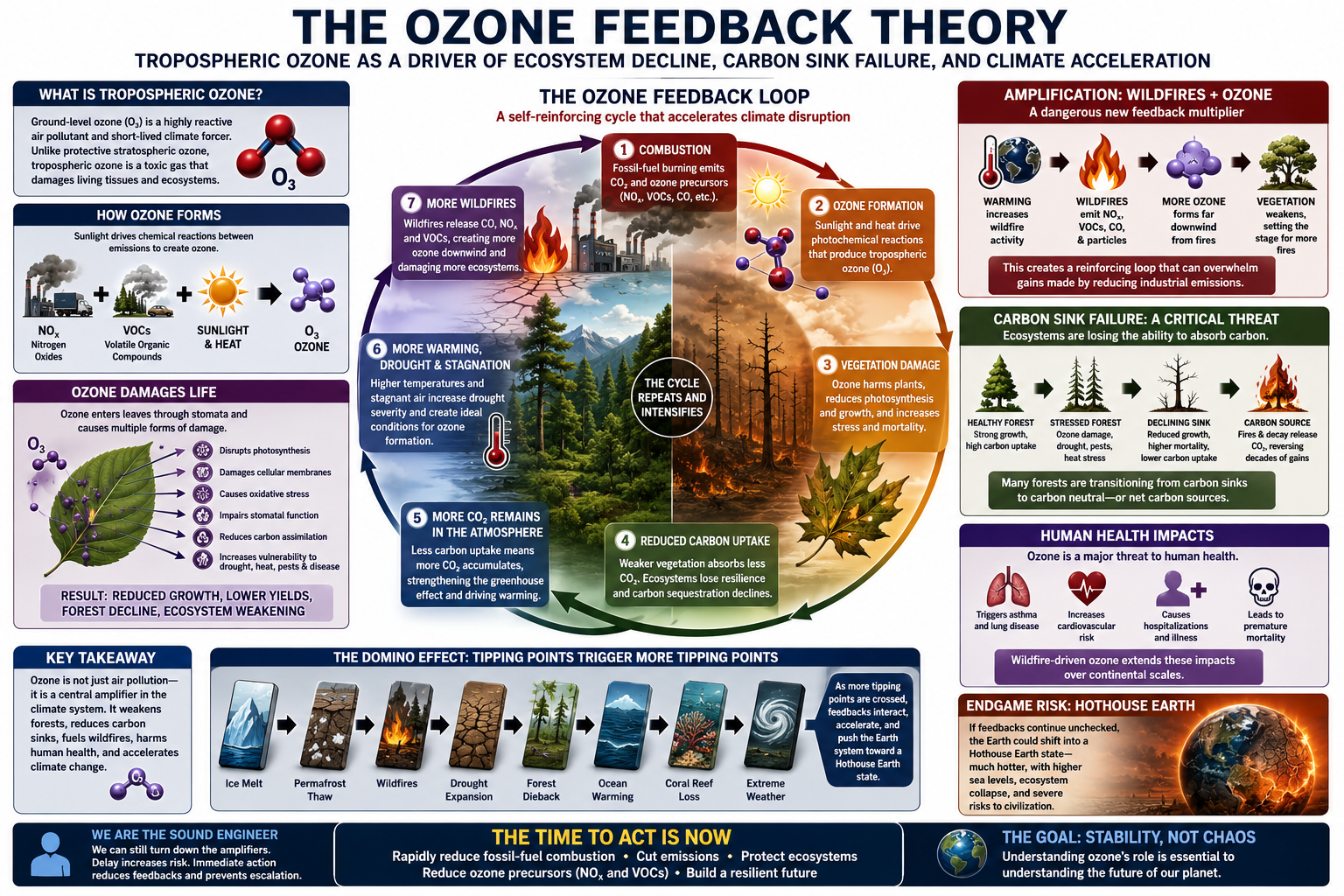
Ozone-Carbon Sink Feedback
Tropospheric ozone damages vegetation, suppresses photosynthesis, and weakens carbon sequestration.
As warming increases lightning activity and wildfire frequency, ozone production increases.
This creates another self-reinforcing feedback:
Warming → More Lightning and Wildfires → More Ozone → Reduced Carbon Uptake → More Warming
Additional Emerging Tipping Elements
Antarctic Sea Ice Regime Shift
Since 2016, Antarctic sea ice has experienced unprecedented declines.
Some researchers now question whether the Southern Ocean has entered a new climatic state characterized by persistently lower sea-ice coverage.
Southern Ocean Circulation Slowdown
The Southern Ocean absorbs enormous quantities of excess heat and carbon dioxide.
Changes in circulation patterns could weaken this planetary buffering system, leaving more heat and carbon in the atmosphere.
Boreal Forest Degradation
Northern forests across Canada, Alaska, and Siberia are increasingly affected by drought, wildfire, insect outbreaks, and ozone stress.
As these forests weaken, one of Earth's largest terrestrial carbon sinks becomes less effective.
Coral Reef Collapse
Coral reefs support approximately one-quarter of all marine species.
Repeated marine heatwaves are pushing many reef systems toward irreversible decline, threatening biodiversity and food security.
The Domino Effect
The greatest danger lies not in individual tipping points but in their interaction.
For example:
- Glacier melt contributes to sea-level rise.
- Freshwater weakens AMOC circulation.
- AMOC disruption alters Amazon rainfall.
- Amazon dieback reduces carbon sequestration.
- Additional warming accelerates Antarctic ice loss.
- Rising temperatures intensify permafrost thaw and wildfire activity.
- Ozone production increases while carbon sinks weaken.
Each step reinforces the next.
Rather than isolated events, tipping points increasingly resemble an interconnected network of cascading risks.
A Planet Entering Uncharted Territory
Recent years have produced unprecedented records for:
- Global surface temperature
- Ocean heat content
- Marine heatwaves
- Atmospheric water vapor
- Wildfire activity
- Glacier mass loss
- Extreme rainfall events
The climate system increasingly exhibits characteristics associated with nonlinear dynamics, where small changes can produce disproportionately large responses.
As critical thresholds are approached, uncertainty grows—not because scientists know less, but because complex systems become inherently less predictable near tipping points.
Sea-Level Rise: An Emerging Tipping Cascade
Sea-level rise represents one of the clearest examples of accelerating climate risk.
Observations indicate that the rate of global sea-level rise has increased substantially since the early 1990s.
Accelerating ice-sheet loss in Greenland and Antarctica raises concerns that future sea-level rise could significantly exceed projections based on simple linear assumptions.
Even modest increases threaten coastal cities, freshwater supplies, agricultural regions, transportation networks, and critical infrastructure worldwide.
Climate, Human Health, and Wet-Bulb Heat
Climate change is increasingly becoming a public health crisis.
One of the most concerning threats involves wet-bulb temperatures, which combine heat and humidity into a measure of physiological stress.
When wet-bulb temperatures approach 31°C (87.8°F), even healthy individuals can struggle to regulate body temperature during prolonged exposure.
As warming continues, regions previously considered safe may periodically experience conditions that challenge human survivability.
Conclusion: The Era of Cascading Risk
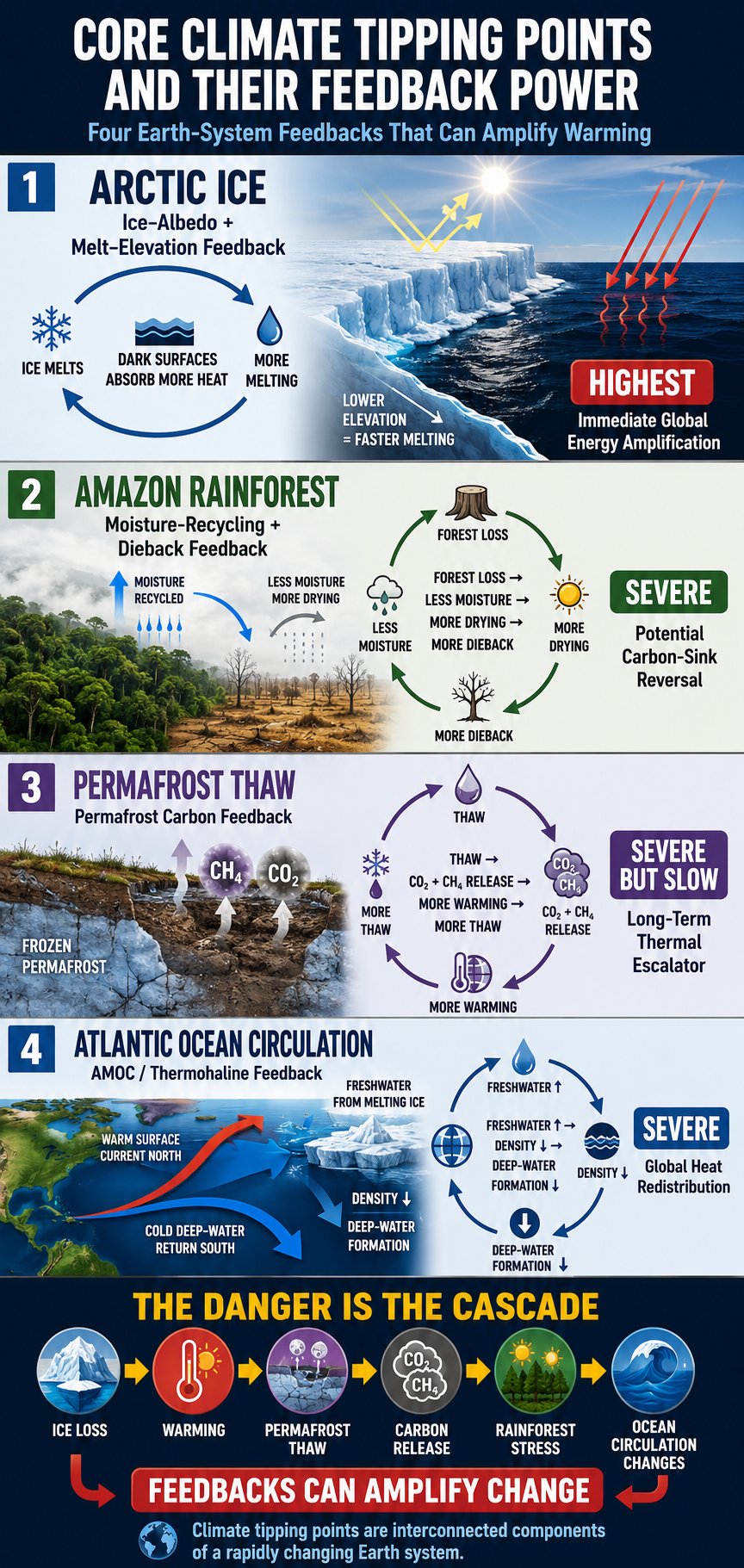
The scientific discussion has evolved significantly over the past decade.
The question is no longer whether climate tipping points exist.
The question is how many have already been activated, how strongly they interact, and whether humanity can slow the cascading processes now underway.
The emerging picture is one of a highly interconnected Earth system in which ice sheets, forests, oceans, ecosystems, atmospheric chemistry, and human societies influence one another through increasingly powerful feedback loops.
The Amazon, Antarctica, AMOC, permafrost, boreal forests, coral reefs, and atmospheric ozone are not isolated risks. Together they form a network of interconnected tipping elements capable of amplifying global change.
Each additional increment of warming increases the probability that new thresholds will be crossed.
The choices made during the next decade will influence not only the climate of this century but the habitability of large portions of the planet for generations to come.
Low-Level Clouds: The +1.5°C Climate Amplifier
Groundbreaking thermodynamic simulations, notably led by researchers at Caltech’s Linde Center, have revealed that low-level clouds possess a critical tipping point.
If greenhouse gas concentrations continue to rise unchecked, marine stratocumulus decks over the Pacific could reach an instability threshold where they fragment and dissolve into scattered, shallow cumulus clouds. Without the vast reflective white sheets to shield the ocean, the dark tropical and subtropical waters would absorb massive amounts of solar energy.
Calculations indicate that the loss of this cloud albedo feedback alone could add an additional 1.5°C to 2°C of global warming. In a tipping point scenario where clouds completely break up under extreme emission tracks, it could trigger a catastrophic, abrupt warming spike.
Even short of a total breakup, observational data from satellites indicates that a gradual thinning of these clouds is already underway. This slow degradation is believed to be a major factor behind the recent acceleration in Earth’s total energy imbalance and ocean heat uptake.
See: Low-Level Cloud Feedback: The Mega-Multiplier — An Additional 1.5°C to 2°C
URGENT CLIMATE WARNING
Our probabilistic, ensemble-based climate framework—which incorporates ecological, economic, atmospheric, and societal feedbacks within a nonlinear dynamic system—suggests that climate risks may increase substantially faster than assumed by traditional linear projections.
The greatest threat is not any single climate impact but the emergence of interconnected tipping cascades capable of destabilizing multiple Earth systems simultaneously.
Evidence suggests that many of these processes are already underway.
The climate system is entering an era defined by compound extremes, cascading risks, and self-reinforcing feedback loops.
Reducing greenhouse gas emissions remains essential. Equally important are adaptation, resilience planning, ecosystem protection, carbon sink preservation, and rapid deployment of clean-energy technologies.
The future is not yet written, but the window for avoiding the most severe outcomes continues to narrow.
Feedback loops amplify climate change and can push interconnected Earth systems past critical tipping points. As tipping points are crossed, they can trigger additional feedback loops and destabilize other climate systems. This cascading "Domino Effect" compresses timescales, accelerates change, and increases the risk of rapid, nonlinear climate transformations.
* Our probabilistic, ensemble-based climate model — which incorporates complex socio-economic and ecological feedback loops within a dynamic, nonlinear system — projects that global temperatures are becoming unsustainable this century. This far exceeds earlier estimates of a 4°C rise over the next thousand years, highlighting a dramatic acceleration in global warming. We are now entering a phase of compound, cascading collapse, where climate, ecological, and societal systems destabilize through interlinked, self-reinforcing feedback loops.