Sea-level Rise: Greenland and the Collapse of the West and East Antarctic Ice Sheets
by Daniel Brouse and Sidd Mukherjee
August 30, 2022 (Updated June 2026)
"Major sea-level rise caused by melting of the Greenland ice cap is now inevitable."
From Linear Assumptions to Nonlinear Reality
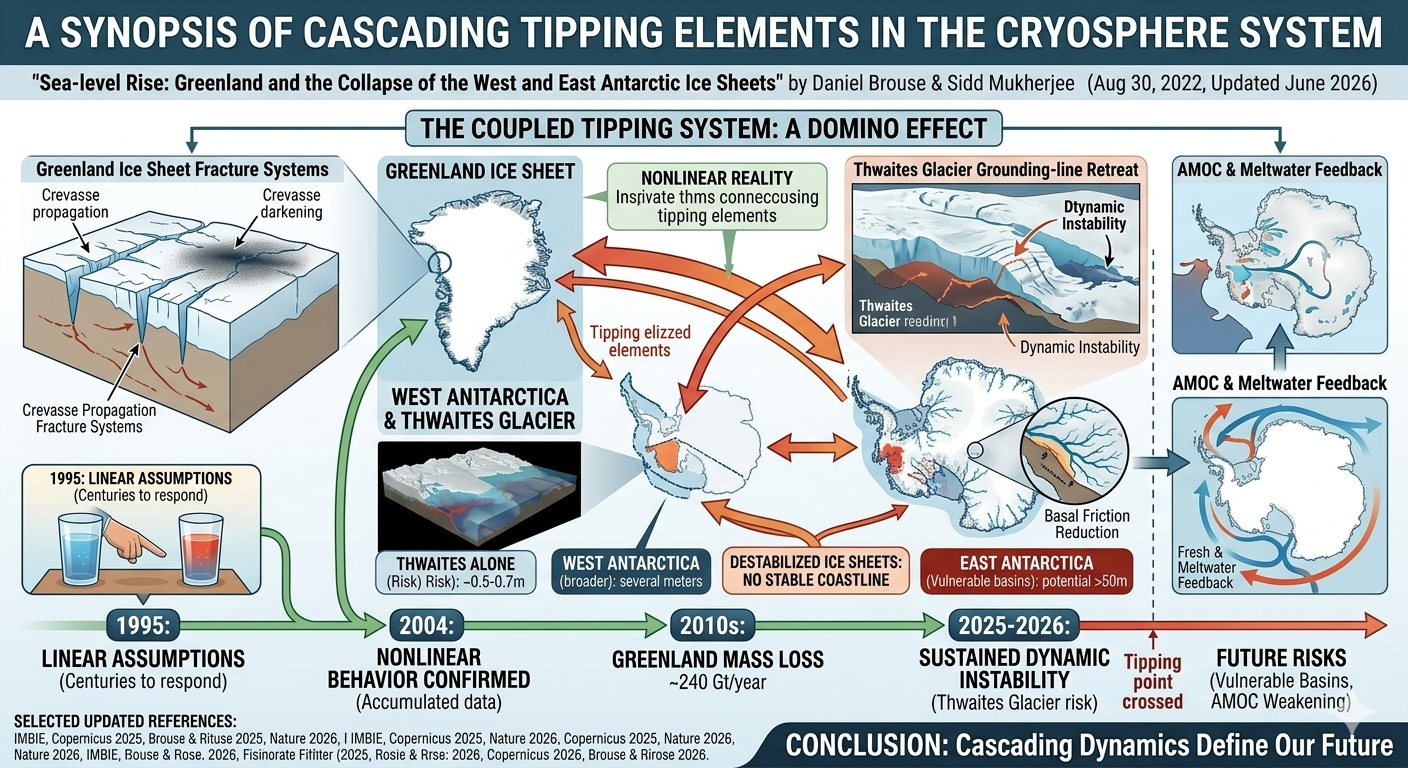
In 1995, I was convinced climate change was happening at an exponential rate; however, Sidd argued we needed more data over a longer time period. At the time, the dominant assumption was that global warming was largely linear and slow—offering centuries to respond.
By 2004, enough observational data had accumulated to confirm accelerating nonlinear behavior in the cryosphere and ocean systems. Greenland ice sheet dynamics, in particular, were no longer consistent with equilibrium assumptions.
Much of climate change can potentially be mitigated or slowed. Ice sheet collapse, however, is largely irreversible on human timescales once critical thresholds are crossed.
"And once we have destabilized these ice sheets, there will be no stable coastline for centuries."
Greenland Ice Sheet: Committed Sea-Level Rise
Recent satellite and field studies confirm that Greenland is already committed to long-term sea-level rise, even under immediate emissions cessation scenarios.
The latest assessments show Greenland has lost thousands of gigatons of ice since the 1990s, contributing over 1.5 cm of global sea level rise, with accelerating loss rates in the 2000s and 2010s.
According to updated IMBIE-based reconstructions, Greenland mass loss is now occurring at roughly ~240 Gt/year in the 2010s, with continued interannual variability but no recovery trend.
The Greenland Ice Sheet contains enough water to raise global sea level by approximately 7 meters if fully melted.
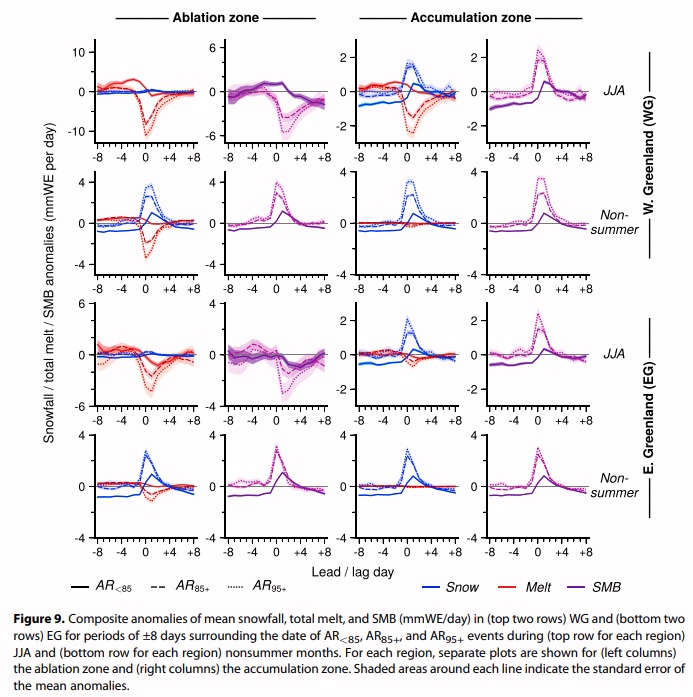
Atmospheric rivers, surface darkening (albedo feedback), and crevasse propagation have all been shown to significantly accelerate melt beyond earlier model expectations.
Antarctica: West Antarctic Instability and Thwaites Glacier
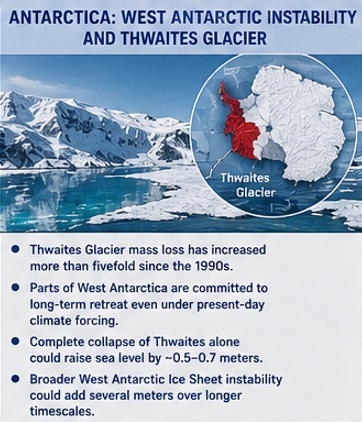
West Antarctica, particularly the Amundsen Sea sector (including Thwaites and Pine Island Glaciers), shows signs of sustained dynamic instability.
Recent modeling studies (2025–2026) indicate Thwaites Glacier mass loss has increased more than fivefold since the 1990s and may continue accelerating through mid-century.
Multiple independent observational and modeling studies now suggest that parts of West Antarctica are committed to long-term retreat even under present-day climate forcing.
Complete collapse of Thwaites alone could raise global sea level by ~0.5–0.7 meters (roughly 2 feet), with broader West Antarctic Ice Sheet instability contributing several meters over longer timescales.
East Antarctica: Low Probability, High Impact Risk
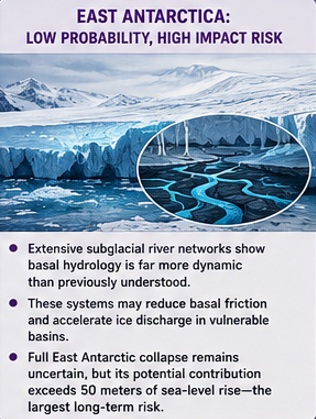
East Antarctica has historically been considered stable; however, new research into subglacial hydrology, marine-terminating basins, and warm ocean intrusion pathways has revised this assumption.
Recent discoveries of extensive subglacial river networks beneath East Antarctica demonstrate that basal hydrology is far more dynamic than previously understood.
These systems may reduce basal friction and accelerate ice discharge in vulnerable basins, particularly where grounding lines are near flotation thresholds.
While full East Antarctic collapse remains uncertain, its potential contribution exceeds 50 meters of global sea-level rise, making it the largest long-term risk in the cryosphere system.
Updated Greenland–Antarctica Observations (2025–2026)
Recent observational summaries show:
- Greenland continues long-term net mass loss despite short-term variability
- Antarctica shows regionally mixed signals but sustained West Antarctic decline
- Combined ice sheets have contributed ~2 cm+ of sea-level rise since the early 2000s
- Sea-level rise rate has approximately doubled since the early satellite era
Recent 2026 assessments confirm continued high glacier mass loss globally, with accelerating contributions to sea level rise from both Greenland and Antarctica.
AMOC and Ocean System Feedbacks
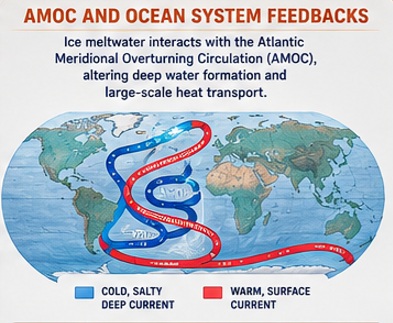
Ice sheet meltwater input from Greenland and Antarctica interacts with the Atlantic Meridional Overturning Circulation (AMOC), potentially altering deep water formation and large-scale heat transport.
Recent modeling results show complex interactions where Antarctic meltwater may partially stabilize AMOC in some scenarios, while Greenland meltwater tends to weaken it.
These coupled tipping elements introduce nonlinear feedback risks that are not well represented in linear projection models.
Conclusion: A Coupled Tipping System
The modern climate system is no longer best understood as a set of independent processes, but rather as a coupled network of interacting tipping elements.
Greenland, West Antarctica, East Antarctica, AMOC, permafrost, and atmospheric circulation systems are increasingly interconnected through feedback loops involving heat, freshwater, and radiation balance changes.
Each additional increment of warming increases the probability that multiple thresholds will be crossed within overlapping timeframes.
The primary uncertainty is no longer whether these systems respond, but how quickly interactions compound once destabilization begins.
The future climate trajectory will be determined not only by emissions, but by the cascading dynamics of Earth’s ice-ocean-atmosphere system.
Selected References (Updated)
- NASA Ice Sheet Mass Balance Observations (Greenland & Antarctica)
- IMBIE Consortium Ice Sheet Reconstructions
- Copernicus Climate Change Service (2025 Greenland Ice Sheet Update)
- Nature / Geophysical Research Letters Thwaites Glacier modeling studies (2026)
- Recent subglacial hydrology studies of Antarctica (Nature Geoscience)
Feedback loops amplify climate change and can push interconnected Earth systems past critical tipping points. As tipping points are crossed, they can trigger additional feedback loops and destabilize other climate systems. This cascading "Domino Effect" compresses timescales, accelerates change, and increases the risk of rapid, nonlinear climate transformations.
* Our probabilistic, ensemble-based climate model — which incorporates complex socio-economic and ecological feedback loops within a dynamic, nonlinear system — projects that global temperatures are becoming unsustainable this century. This far exceeds earlier estimates of a 4°C rise over the next thousand years, highlighting a dramatic acceleration in global warming. We are now entering a phase of compound, cascading collapse, where climate, ecological, and societal systems destabilize through interlinked, self-reinforcing feedback loops.