The Domino Effect
Warming → Feedback Activation → Feedback Coupling → Amplification → Tipping-Point Threshold → CascadeThe climate system is not simply warming—it is changing how it responds to that warming. Coupled climate feedbacks are becoming one of the most consequential dimensions of climate risk in the 21st century because they amplify changes and connect individual tipping-point pathways into larger cascading effects.
Warming-induced natural feedback emissions from permafrost, wetlands, freshwaters, and wildfires are accelerating so fast that they will likely amplify human-caused global warming by 20% to 30% this century. In addition, low-level cloud feedback could contribute an additional 1.5°C to 2°C of global warming. In a tipping point scenario where clouds completely break up under extreme emission tracks, it could trigger a catastrophic, abrupt warming spike.
The longer warming persists, the more climate feedbacks become active. As these feedbacks interact, we are already observing nonlinear responses, amplification, and cascading impacts across the climate system. Hundreds of feedback mechanisms have been identified, and many can couple and reinforce one another, contributing to the accelerating pace and increasing magnitude of climate change—The Domino Effect.
By Daniel Brouse and Sidd Mukherjee
Climate feedbacks are processes in which an initial change in Earth’s climate system triggers additional changes that amplify or dampen the original change. Positive feedbacks amplify the initial warming caused by greenhouse-gas emissions, accelerating climate change beyond what the initial forcing alone would produce.
As Earth’s climate system warms and destabilizes, millions of emerging feedback interactions are becoming active across the atmosphere, oceans, cryosphere, land, and living systems. Many of these interactions are now being observed for the first time in human history. As individual feedbacks activate, strengthen, and interact with one another, they create new pathways for amplifying climate change and accelerating Earth-system change.
Two examples of feedbacks that can double the impacts of climate change: Water Vapor and Thermal Expansion Feedbacks
In the 1990s, the Membrane Domain initiated groundbreaking research on human-induced climate change, challenging the prevailing linear models of global warming. Our research introduced a nonlinear, exponential model--akin to the shape of a bathtub curve or hockey stick--which has since been repeatedly confirmed by real-world data.
At the heart of this acceleration are feedback loops, also known in climate science as positive feedback mechanisms. These are processes where an initial change in a system leads to additional changes that reinforce and amplify the original effect. Though technically "positive," their consequences for the planet are overwhelmingly negative. Examples include Ice-Albedo Feedback, Water Vapor Feedback, Carbon Cycle Feedback, Ocean Circulation Feedback, Vegetation-Climate Feedback, Cloud Feedback, and Disease, Pollution, and Extreme Weather Health Feedbacks.
| Feedback Loop | Mechanism | Amplifying Effect |
|---|---|---|
| Ice-Albedo | Melting ice exposes darker surfaces | More heat absorption, more ice melt |
| Water Vapor | Warmer air holds more moisture | Increased greenhouse effect |
| Permafrost Thaw | Releases methane and CO2 | Intensifies warming, thaws more permafrost |
| Vegetation Loss | Fewer plants absorb CO2 | More atmospheric CO2 |
| Brown Carbon | Darkens snow/ice, reduces albedo | Faster melting and warming |
| Forest Fires | Emit CO2 and dark particles | Raise temps, spark more fires |
| Lightning | Increased by warming | More fire ignition events |
| Epigenetic DNA Changes | Disease, Pollution, and Extreme Weather | Long-term vulnerability across multiple organ systems |
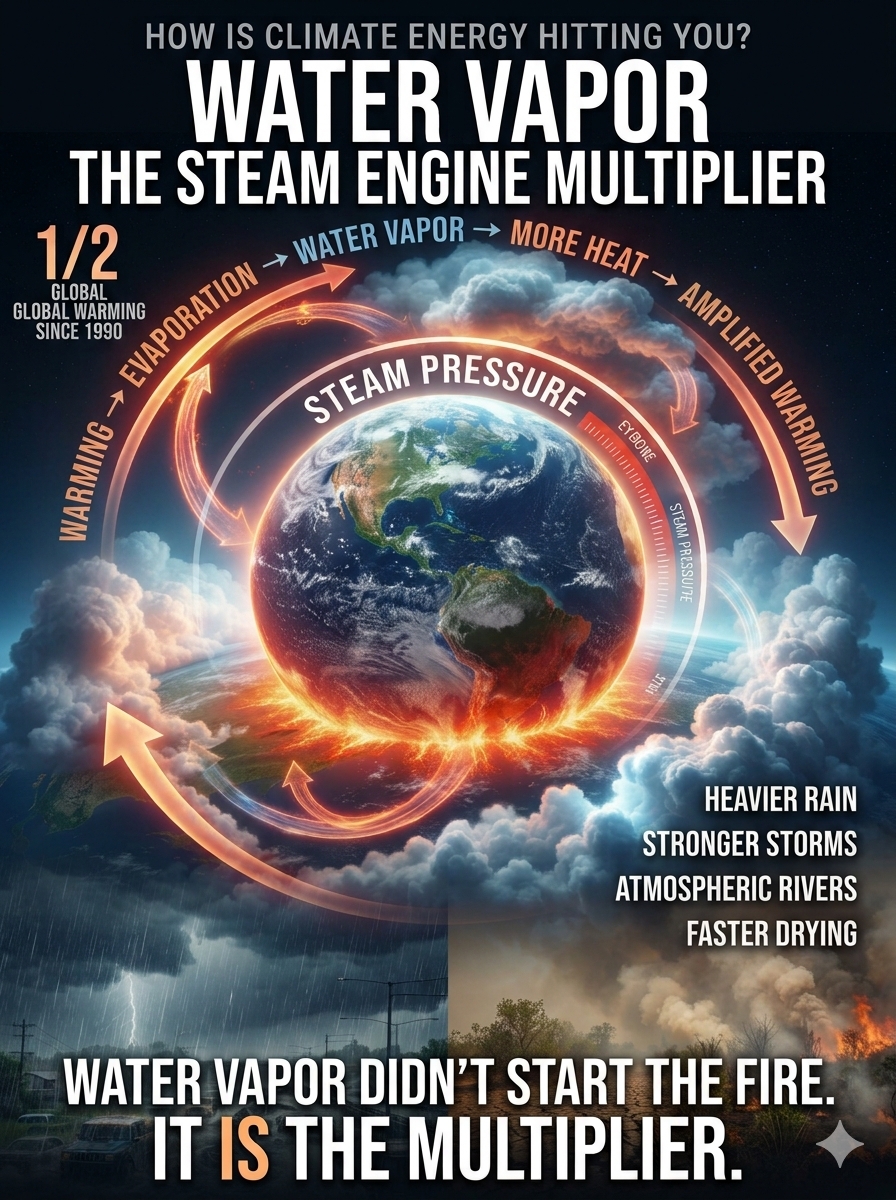
Water vapor is the greatest climate amplifier, acting as Earth’s most powerful natural feedback mechanism.
While greenhouse gases such as carbon dioxide (CO₂) and methane (CH₄) are the primary drivers of human-caused climate change, water vapor amplifies and multiplies their warming effects.
This amplification operates through a continuous, compounding feedback loop:
Initial Warming: Human activities release greenhouse gases, primarily through the burning of fossil fuels, which warms the atmosphere.
Increased Evaporation: A warmer atmosphere can hold more moisture. For every 1°C of warming, the atmosphere’s water-holding capacity increases by about 7%.
Amplified Greenhouse Effect: Water vapor is itself a greenhouse gas. As atmospheric moisture increases, it traps more of the heat radiated from Earth’s surface, producing additional warming. The result is a powerful feedback cycle: warming increases evaporation and atmospheric moisture; increased water vapor traps more heat; and that additional heat promotes further evaporation and moisture accumulation.
Of the global warming experienced since 1990, water vapor is responsible for roughly half of it.
Most Powerful Feedback: Water Vapor — the Greatest Climate Amplifier
The Reign of Violent Rain
Clouds are different. Climate change is altering their amount, altitude, thickness, reflectivity, lifetime, and geographic distribution—changing how much solar energy is reflected and how much infrared heat is retained.
How does changing albedo affect cloud formation, particularly over the tropics? And what happens to the climate if those clouds increase—or decrease?
Low clouds are especially important because they can reflect substantial amounts of incoming sunlight back into space. If tropical low clouds diminish, the ocean could absorb significantly more solar energy, accelerating warming.
Clouds are arguably the largest remaining uncertainty in our understanding of climate sensitivity. They can reflect incoming solar radiation, producing a cooling effect, while high, thin clouds can allow incoming sunlight through while trapping outgoing heat.
Which effect dominates—and how that balance changes as the planet warms—is one of the great unanswered questions in climate science.
Leading research suggests that the loss of low-level cloud albedo could contribute an additional 1.5°C to 2°C of global warming.
That would not be a minor correction to the climate trajectory.
It may be The Mega-Multiplier. Under a tipping point scenario in which low-level clouds substantially break up, the resulting loss of their cooling effect could produce a catastrophic and potentially abrupt warming spike.
See: Low-Level Cloud Feedback: The Mega-Multiplier — An Additional 1.5°C to 2°C
Individually, water vapor and cloud feedbacks are amplifying warming. Together, their interactions can reinforce climate change, intensify climate-system responses, and increase the potential for multiple tipping points to interact and amplify one another.
Water Vapor + Clouds: Coupled Feedbacks Driving a Warmer Planet
Melting Arctic sea ice reduces the Earth's reflectivity (albedo), exposing darker ocean surfaces that absorb more heat. This accelerates warming, ice melt, and the release of potent greenhouse gases like methane. A 2022 Nature study found the Arctic is warming nearly four times faster than the global average since 1979, triggering multiple reinforcing loops:
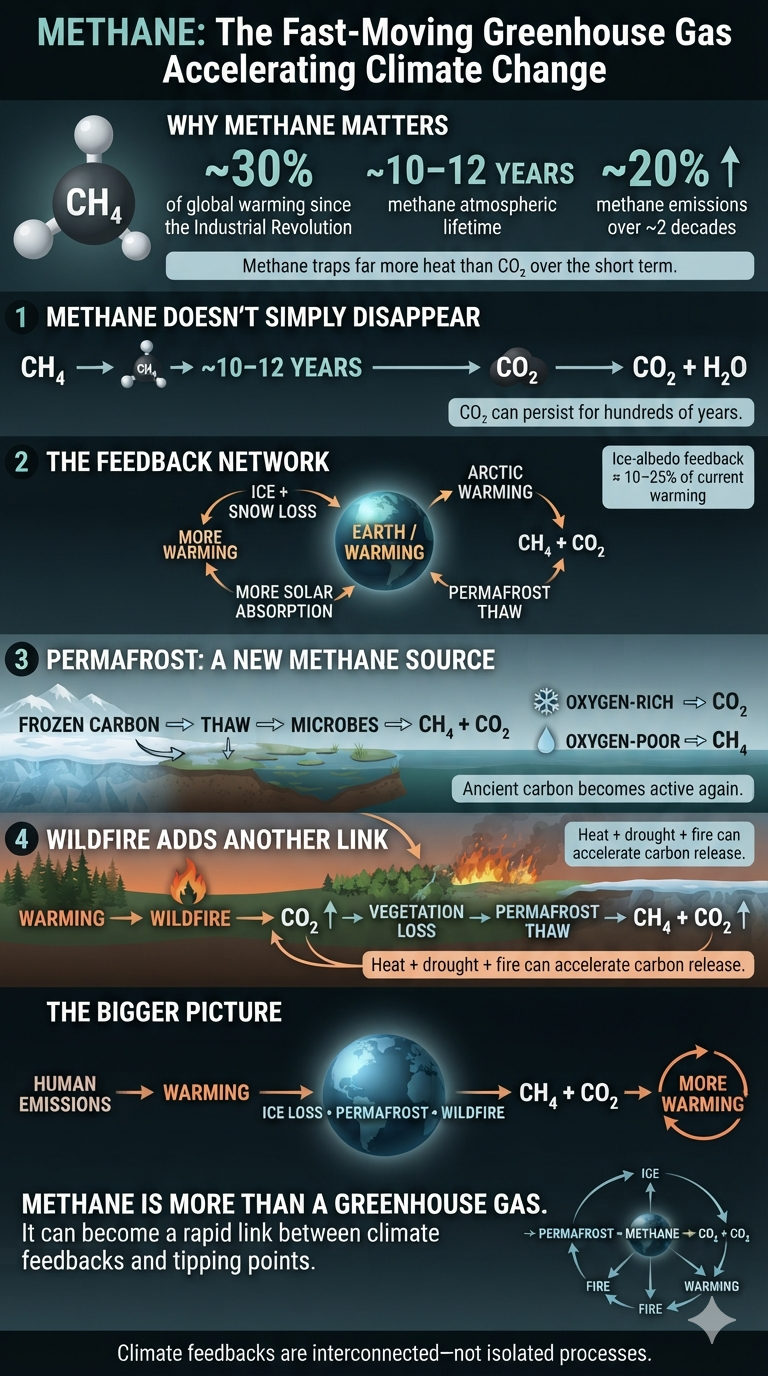
Methane (CH4) is more than a powerful greenhouse gas. As the climate warms, it has become a rapid link between interacting feedbacks and tipping points, helping connect processes that reinforce one another.
Methane remains in the atmosphere for roughly 10–12 years, but it traps substantially more heat than CO2 over short time horizons. And when methane oxidizes, its carbon is ultimately converted into CO2, which can continue influencing the climate system for hundreds of years.
🔥 The bigger concern is what warming is already activating.
Ice & snow loss → greater solar absorption → Arctic warming → permafrost thaw → CH4 + CO2 release → more warming
Then wildfire adds another powerful connection:
Warming → more severe wildfire → CO2 emissions → vegetation & soil loss → accelerated permafrost thaw → additional CH4 + CO2 → further warming
The result is an increasingly interconnected climate system in which one feedback can strengthen another.
The central concern isn't simply rising methane emissions. It is that warming itself is activating additional methane sources and strengthening existing feedbacks, while increasing pressure on other climate tipping points.
Methane has become a rapid amplifier linking physical, biological, and chemical processes across the Earth system.
Learn more about: Methane: A Rapid Link Between Feedbacks and Tipping Points
Warmer weather brings rain instead of snow, reducing surface albedo. NASA has shown how Greenland's ice sheet has darkened due to loss of reflective fresh snow, replaced by older snow with more impurities, accelerating melting and sea level rise.
Hotter temperatures increase lightning, sparking more wildfires that release CO2 and brown carbon. Brown carbon settles on snow and ice, darkening surfaces and speeding up melt. According to Forests at Risk Due to Lightning Fires, 77% of forest fires in intact non-tropical regions are now lightning-caused. Lightning strikes are projected to increase by 11-33% per degree of warming.
"Thousands of lightning strikes in remote forests can spark hundreds of small fires. These merge into mega-fires--blazes the size of small countries. Once they reach this scale, they're nearly impossible to stop."
-- Prof. Sander Veraverbeke
The Canadian wildfires of 2023 released more CO2 than nearly any country annually, and in some areas, permafrost is now burning year-round.
How the growing need for air conditioning is creating new reinforcing climate feedbacks
More heat increases demand for air conditioning, which often uses fossil fuels and HFCs, potent greenhouse gases. This creates a vicious cycle:
More Heat → Higher Cooling Demand → Greater Electricity Use → More Greenhouse Gas Emissions → More Global Warming → More Heat
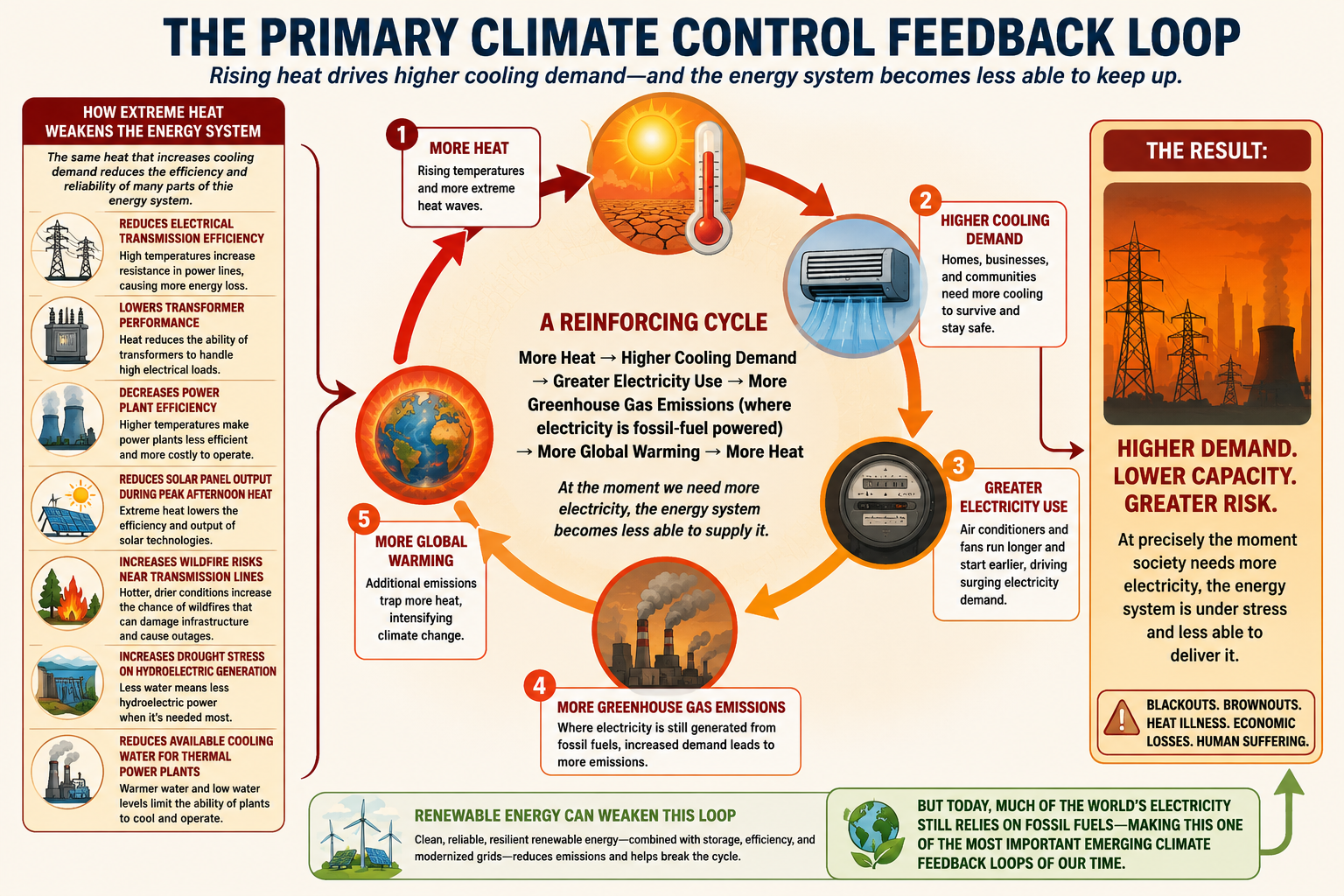
For most of the twentieth century, air conditioning was considered a luxury in many parts of the world. Today, in an increasing number of regions, it is becoming essential for human health and survival. As climate change drives longer, hotter, and more humid heat waves, indoor climate control is rapidly shifting from a convenience to a critical component of public safety.
This transition carries an important consequence that is often overlooked: climate control itself is becoming part of the climate system. Cooling technologies are increasingly intertwined with energy production, infrastructure resilience, water availability, urban design, and greenhouse gas emissions. As societies become more dependent on mechanical cooling, air conditioning becomes linked to a growing number of reinforcing climate feedback loops.
Many of these feedbacks are indirect, but together they form an interconnected system capable of amplifying both climate risks and societal vulnerability. Understanding these emerging “climate control feedback loops” is becoming increasingly important as the world enters an era of persistent extreme heat.
Climate Control Feedback Loops: When Cooling Becomes Part of the Climate System
Climate change is also a health crisis driven by overlapping feedback loops. These include infectious diseases, pollution, and heat-driven cellular breakdown, all exacerbated by compounding, nonlinear effects. Heat exposure accelerates biological aging and worsens conditions like cancer and dementia. Epigenetic changes from stressors like ozone and COVID-19 can activate disease-linked genes and affect future generations.
Climate-Driven Health Collapse: Disease, Pollution, and Extreme Weather
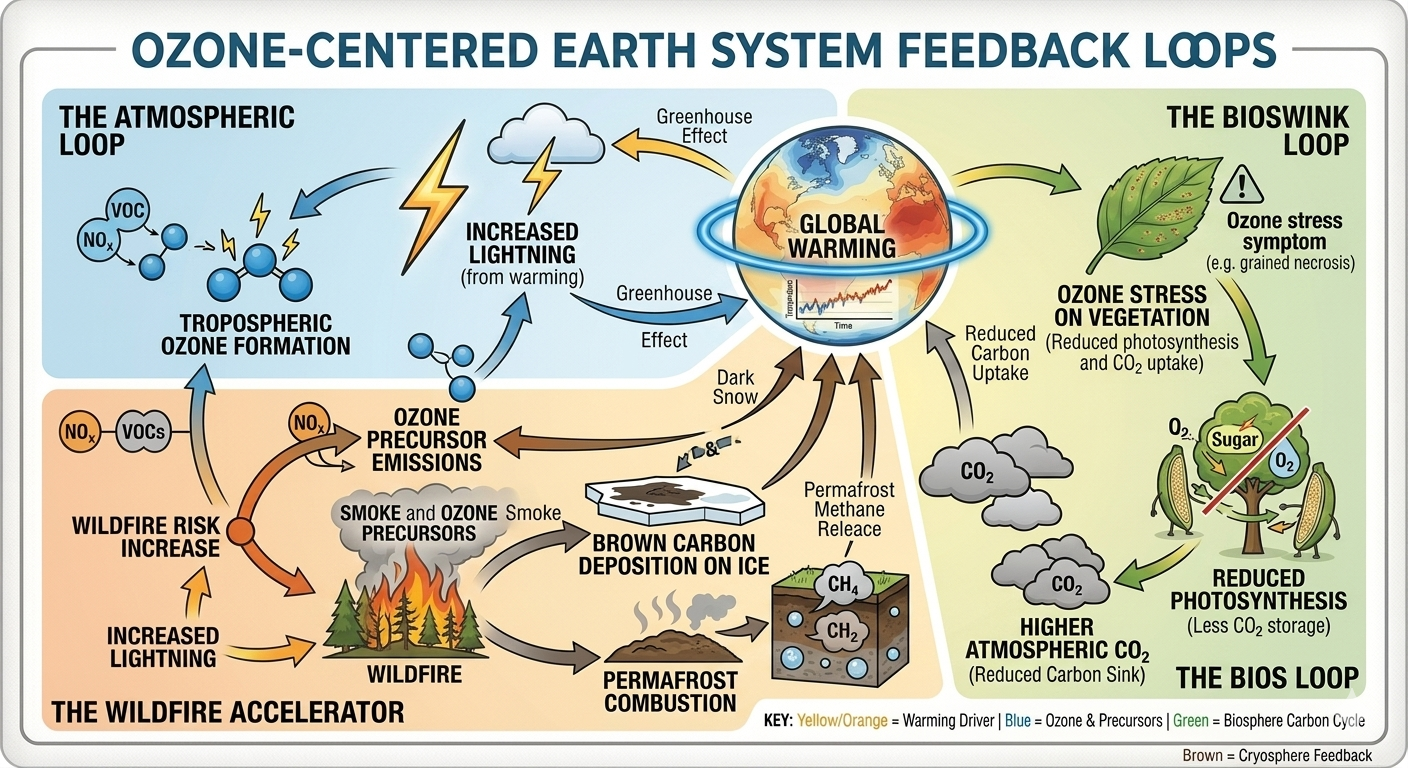
Tropospheric ozone is not merely a byproduct of climate change—it is a critical Earth-system coupling agent that links atmospheric warming, lightning activity, ecosystem health, wildfire dynamics, carbon-cycle disruption, human health, and cryosphere processes into a network of interconnected feedbacks capable of accelerating global warming.
The emerging role of ozone within so many coupled feedback mechanisms illustrates both the extraordinary complexity of atmospheric physics and chemistry and the profound interconnectedness of the Earth’s climate system. Rather than operating through a single pathway, ozone influences climate through multiple atmospheric, biological, ecological, and cryospheric processes simultaneously. It acts as a greenhouse gas that directly contributes to warming, a biological toxin that damages vegetation and weakens carbon sinks, and an ecological stressor that increases vulnerability to drought, disease, and wildfire.
The emerging Earth-system framework can be viewed as a series of interconnected feedback loops centered on ozone:
Atmospheric Pathway
Warming → Lightning → Ozone → Warming
Ecosystem Pathway
Ozone → Reduced Photosynthesis → Reduced Carbon Uptake → Higher CO₂ → Warming
Wildfire Pathway
Ozone → Vegetation Stress → Increased Wildfire Risk → More Ozone
Lightning–Wildfire Pathway
Warming → Lightning → Wildfires → Ozone Precursors → More Ozone
Cryosphere Pathway
Wildfires → Brown Carbon → Reduced Albedo → Warming
Permafrost Pathway
Wildfires → Permafrost Combustion → CO₂ and CH₄ Release → Warming
Together these feedbacks form a coupled network connecting atmospheric chemistry, ecosystem productivity, wildfire dynamics, cryosphere stability, and carbon-cycle feedbacks.
Lightning-Generated Tropospheric Ozone and Earth-System Feedbacks
Tropospheric Ozone as a Driver of Ecosystem Decline, Carbon Sink Failure, and Climate Acceleration
Climate change isn’t just one feedback causing another.
It’s becoming a network of interacting feedbacks where seemingly unrelated processes reinforce each other in ways that traditional linear thinking struggles to capture. Some of the most fascinating—and concerning—climate feedback loops are ones that were barely considered in climate models a decade ago. They illustrate how a relatively small change can trigger a cascade of nonlinear responses, making them particularly relevant from a chaos theory perspective.
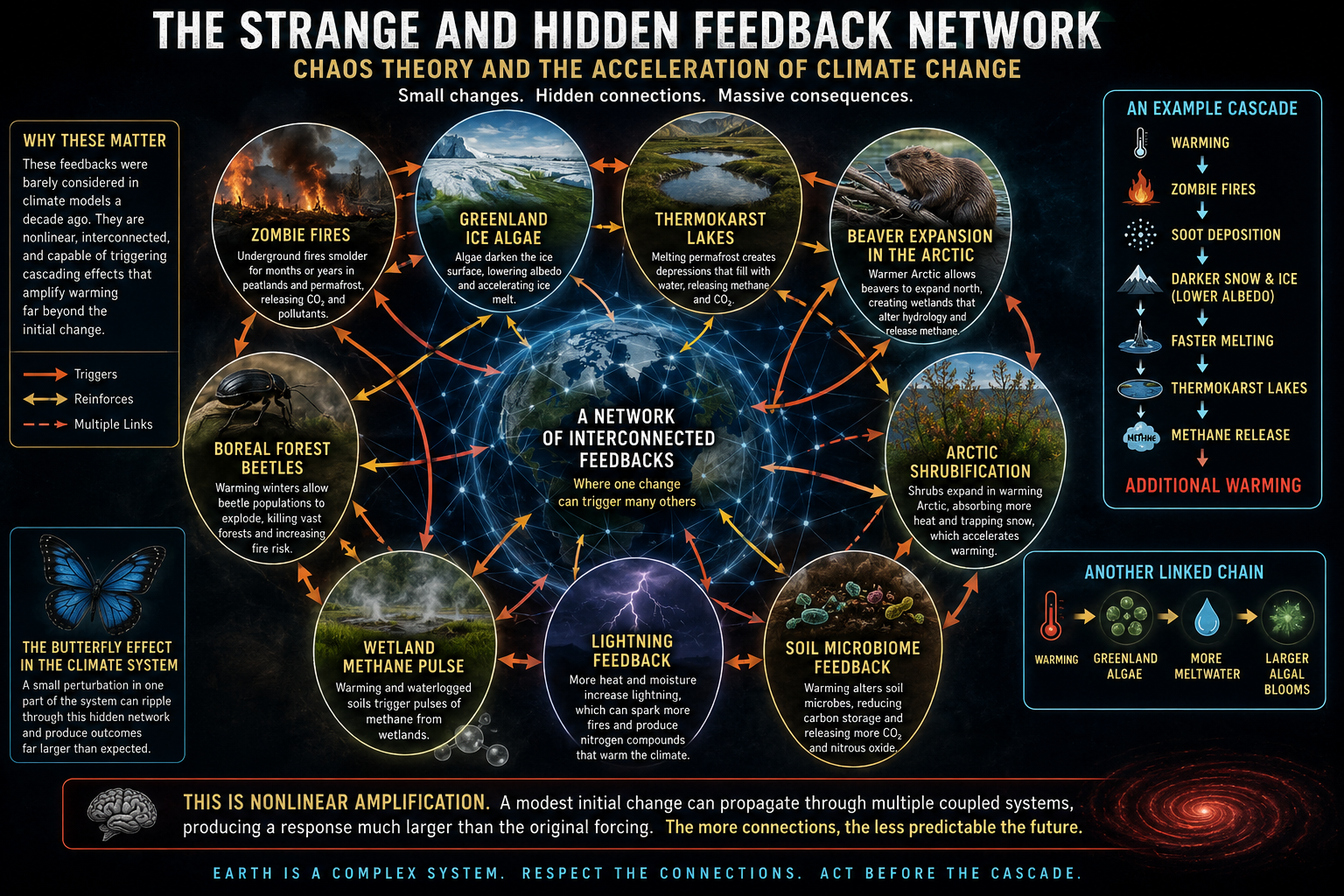
🔥 Zombie Fires
🟢 Greenland Ice Algae
🏞️ Thermokarst Lakes
🦫 Arctic Beaver Expansion
🪲 Boreal Forest Beetles
🌿 Arctic Shrubification
💨 Wetland Methane Pulses
⚡ Lightning Feedback
🦠 Soil Microbiome Feedback
These systems don’t operate independently.
A small change can trigger multiple connected responses that amplify one another—a climate-scale example of the Butterfly Effect.
For example:
Warming → Zombie Fires → Soot on Ice → Lower Albedo → Faster Melting → Thermokarst Lakes → Methane Release → More Warming
This is nonlinear amplification: modest initial changes propagating through interconnected systems to produce responses far larger than the original disturbance. As these hidden connections strengthen, predicting climate behavior becomes increasingly difficult using simple cause-and-effect models. Understanding the network is becoming just as important as understanding the individual feedbacks.
🌍 Every new connection matters.
The Strange and Hidden Feedback Network: Chaos Theory and the Acceleration of Climate Change
Feedback loops are active and interlinked, accelerating the breakdown of Earth's climate. When they interact with tipping points, they can trigger cascading domino effects that lead to widespread ecological and societal collapse. This is no longer a theoretical risk but a present and growing emergency.
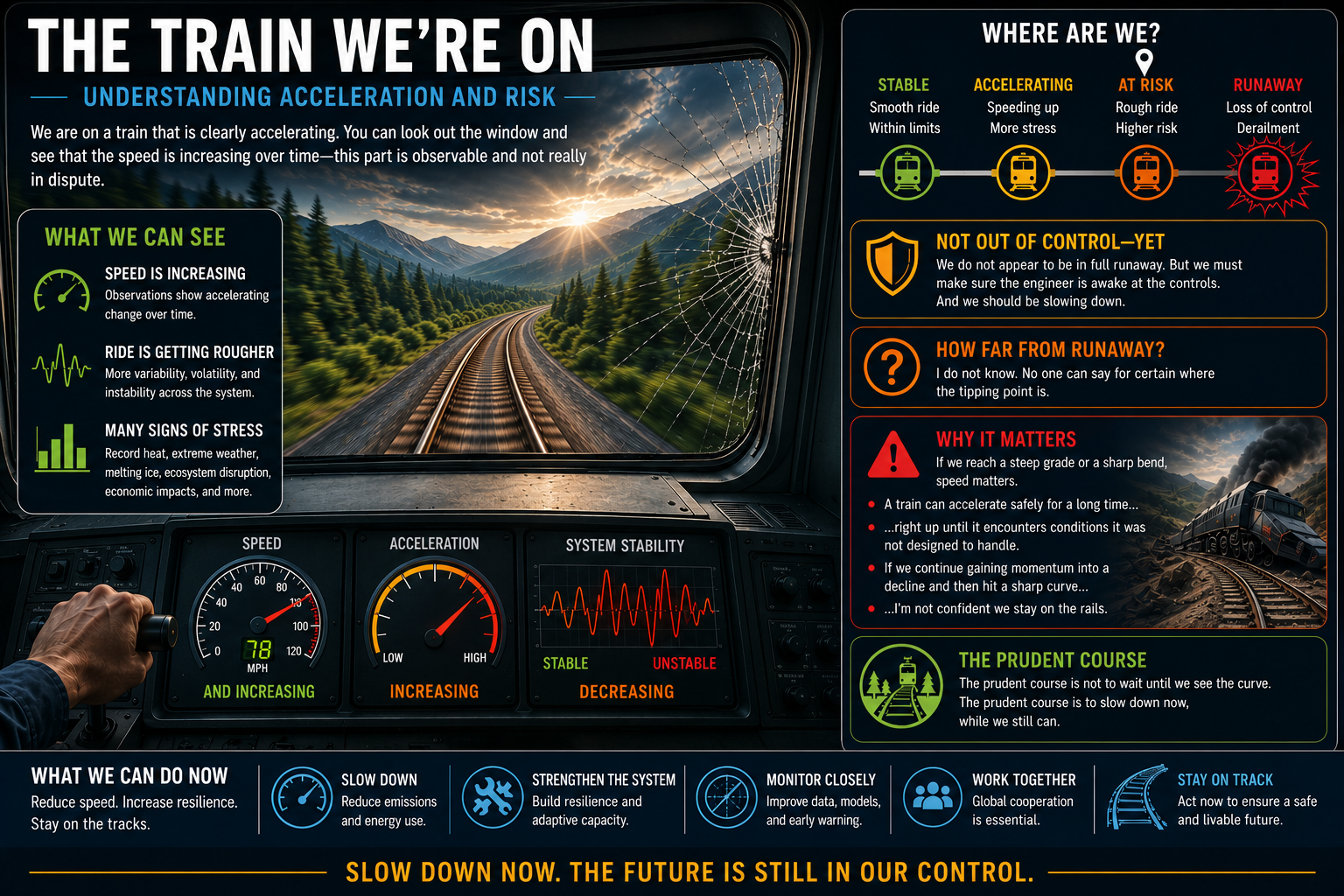
A useful way to think about climate change is through the analogy of an accelerating train.
Imagine riding on a train.
Looking out the window, you can clearly see that the train is moving faster than it was before. That increase in speed is observable and largely undisputed. At the same time, the ride is becoming less smooth. There is more vibration, more instability, and greater variability throughout the system.
The train is still on the tracks.
The engineer still has control.
But momentum is increasing.
The critical question is not whether the train is moving. The critical question is what lies ahead.
A train can safely accelerate for a very long time under favorable conditions. Problems arise when increasing speed encounters constraints that the system was not designed to handle.
A steep decline.
A sharp curve.
A damaged bridge.
The faster the train is moving when it reaches those conditions, the more difficult it becomes to avoid derailment.
Climate change presents a similar risk-management challenge.
The prudent course is not to wait until the curve becomes visible.
The prudent course is to reduce risk while options remain available.
Explore the Complete Runaway Train Scenario
One last analogy for musicians.
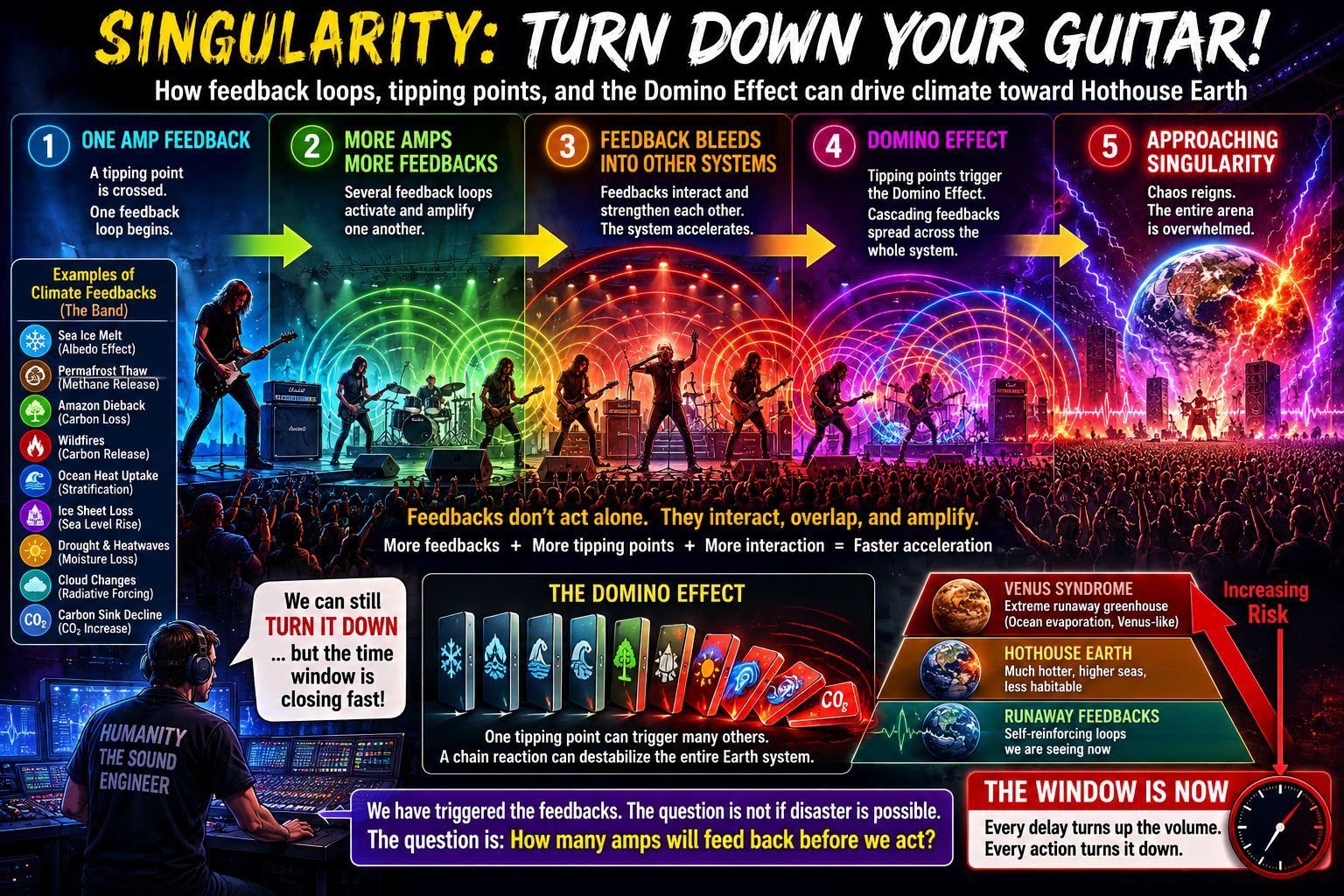
A band is on stage, and a guitar amp begins to feed back. Left unchecked, the feedback becomes self-reinforcing. As it grows more intense, it triggers feedback in the vocalist’s microphone, which in turn triggers feedback in the stage monitors. The cascading feedbacks spread throughout the sound system, resulting in pure chaos across the entire arena – “approaching” singularity.
So when the sound engineer yells at the guitarist to “turn it down,” that’s essentially where we are today.
The Earth has at least several dozen major tipping points. At present, roughly nine appear to have entered self-reinforcing feedback loops. This is like having a large band with nine guitarists, each trying to hear themselves over the others. As a result, each guitarist turns up their amplifier a little louder. Soon, all nine amps are feeding back.
Humanity is the sound engineer. We must take immediate action because these feedbacks can spill over and trigger additional feedbacks. Those new feedbacks can then amplify the original ones, creating a cascading network of self-reinforcing processes.
A simple real-world example is sea ice melt and the albedo effect. As highly reflective sea ice melts, it exposes darker ocean water that absorbs more solar energy. This is analogous to the first guitarist turning the amplifier up too loud and creating feedback. The darker ocean surface warms more rapidly, accelerating the melting of additional ice and exposing even more dark water.
It is possible that this process has entered a self-reinforcing runaway feedback loop. However, it is important to recognize that not all runaway processes continue indefinitely. Once the sea ice is largely gone, that particular feedback will eventually reach its limit and stabilize. In the meantime, however, it can amplify numerous other feedbacks throughout the climate system, including those that affect carbon storage and carbon dioxide sequestration.
Explore the Complete Runaway Guitar Feedback Scenario
Definitions of: runaway climate indicator feedbacks, runaway greenhouse effect, Hothouse Earth, Venus Syndrome, and singularity
Unfortunately, the underlying science increasingly points in that direction. More importantly, it highlights what may be the most critical issue facing society today: not whether climate change is occurring, but whether we are approaching thresholds beyond which many impacts become effectively irreversible on human timescales.
None of us are arguing that the entire Earth system is in a fully runaway state today. However, observations accumulated over the past four decades suggest that multiple climate indicators are accelerating faster than many earlier projections anticipated. We are also observing increasing evidence of self-reinforcing feedback loops emerging across interconnected climate, ecological, and economic systems.
The central question is no longer whether runaway behavior is possible in principle. The question is how we recognize the transition if and when enough individual subsystems enter self-reinforcing states that the larger coupled system begins exhibiting runaway characteristics of its own.
Our observations, along with those of many other researchers over the past four decades, indicate a significant acceleration in climate-related impacts and feedbacks. When we first developed portions of this hypothesis in the 1990s, observed acceleration rates were closer to what could be described as roughly 2¹-fold per century behavior. More recent analyses across multiple independent datasets suggest substantially shorter characteristic timescales, with amplification patterns closer to 2⁶-fold behavior on decadal scales.
This is known as “jerk” behavior. In physics, jerk is the term for the third derivative of position—the rate at which acceleration itself changes. It’s also a useful term because people can relate to it intuitively: it’s what you feel when acceleration changes abruptly, such as when a car suddenly lurches forward or brakes hard. On a graph, that same behavior appears as a sharp bend or sudden change in the acceleration curve.
I’m using the term both in its formal physical sense and because it makes the concept legible outside a technical audience. And we are already experiencing multiple climate “jerks” as a society: abrupt shifts in stress, disruption, and acceleration that people can feel in real time. The graphic highlights ten examples of climate jerks that many people have likely already experienced.
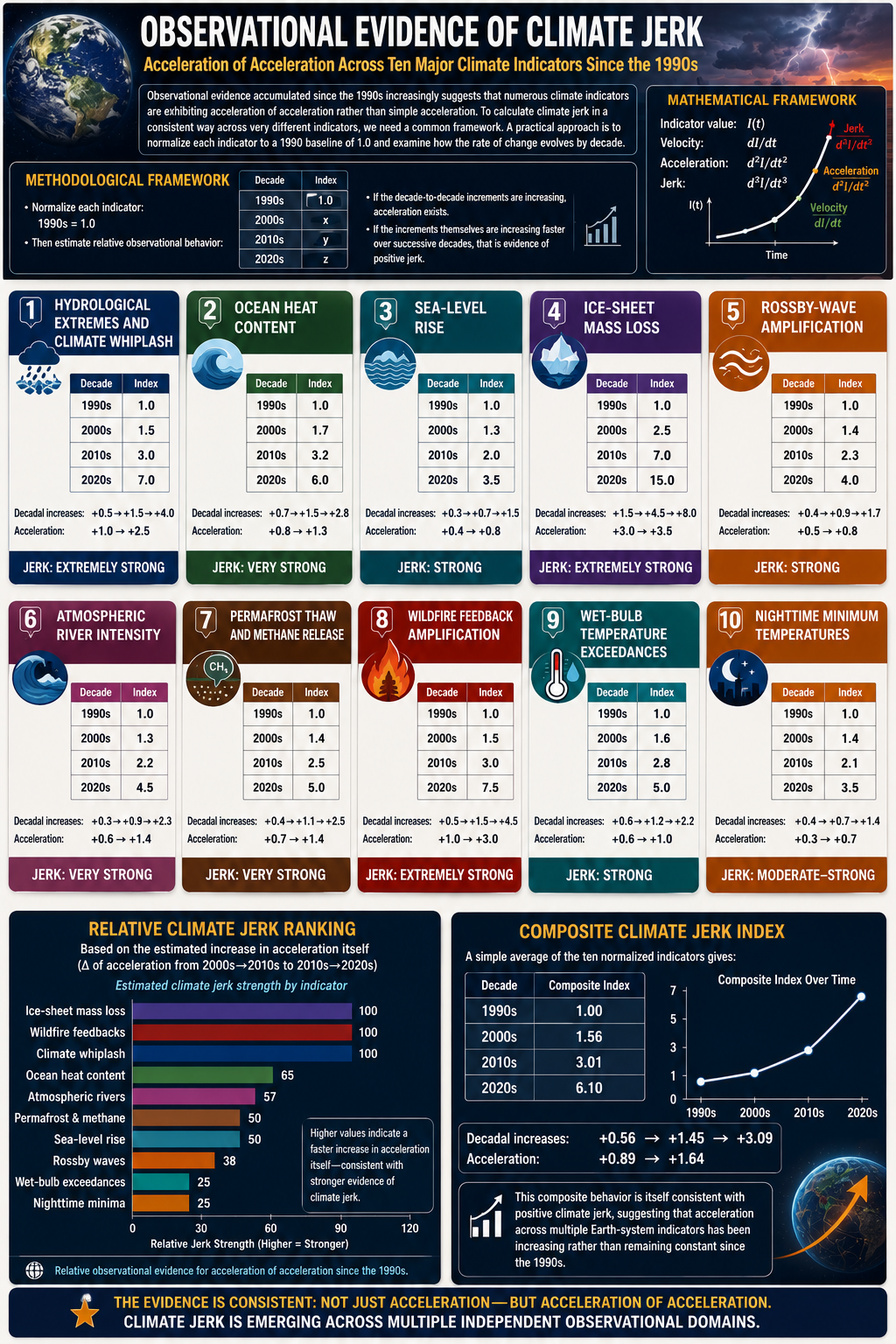
Depending on how the calculations are formulated, this implies:
The exact numbers remain a matter of scientific debate, but the broader trend is increasingly difficult to ignore: the system appears to be accelerating faster than many earlier projections anticipated.
By 2023, multiple feedback loops were becoming directly observable in real-world data. Because of that, the question is no longer whether self-reinforcing climate processes are possible. The more important question is how we will recognize when enough interacting feedbacks have pushed the larger system beyond a critical threshold.
What is already clear is that substantial climate change has been locked in for at least the next several generations, even under extremely aggressive emissions reductions. If emissions continue and additional tipping elements become engaged, the probability of triggering broader system-wide instability increases significantly.
That is why the debate is shifting away from whether climate change is occurring and toward understanding the speed, scale, and interaction of the feedbacks that are now emerging.
Example: Amazon Rainforest Dieback
Example: Cryosphere Tipping Points and Ice Sheet Collapse
Polar amplification → weakened equator-to-pole temperature gradients → reduced thermal contrast that helps drive and stabilize large-scale atmospheric circulation → accelerated Greenland and Arctic ice melt → freshwater input into the North Atlantic and reduced salinity/density of surface waters → disruption and potential weakening of the Atlantic Meridional Overturning Circulation (AMOC) → reorganization of North Atlantic pressure fields and storm tracks → greater jet-stream waviness, slower progression, and amplified Rossby-wave behavior → more persistent blocking patterns, omega blocks, and meridional flow → stalled atmospheric rivers, prolonged heat domes, drought-flood swings, and other forms of hydroclimatic whiplash → destabilization of agriculture, infrastructure, ecosystems, and public health systems → accelerated land-ice loss and groundwater redistribution that shift mass across the planet → climate-driven mass redistribution sufficient to measurably alter Earth’s moment of inertia and contribute to changes in rotational dynamics, including a slight slowing of Earth’s rotation and changes in the length of day.
Example: Jerk-Behavior in Earth’s Rotation
* Our probabilistic, ensemble-based climate model — which incorporates complex socio-economic and ecological feedback loops within a dynamic, nonlinear system — projects that global temperatures are becoming unsustainable this century. This far exceeds earlier estimates of a 4°C rise over the next thousand years, highlighting a dramatic acceleration in global warming. We are now entering a phase of compound, cascading collapse, where climate, ecological, and societal systems destabilize through interlinked, self-reinforcing feedback loops.