Glacial Retreat: Ice Melt, Sea Level Rise, and the Local Consequences
Introduction
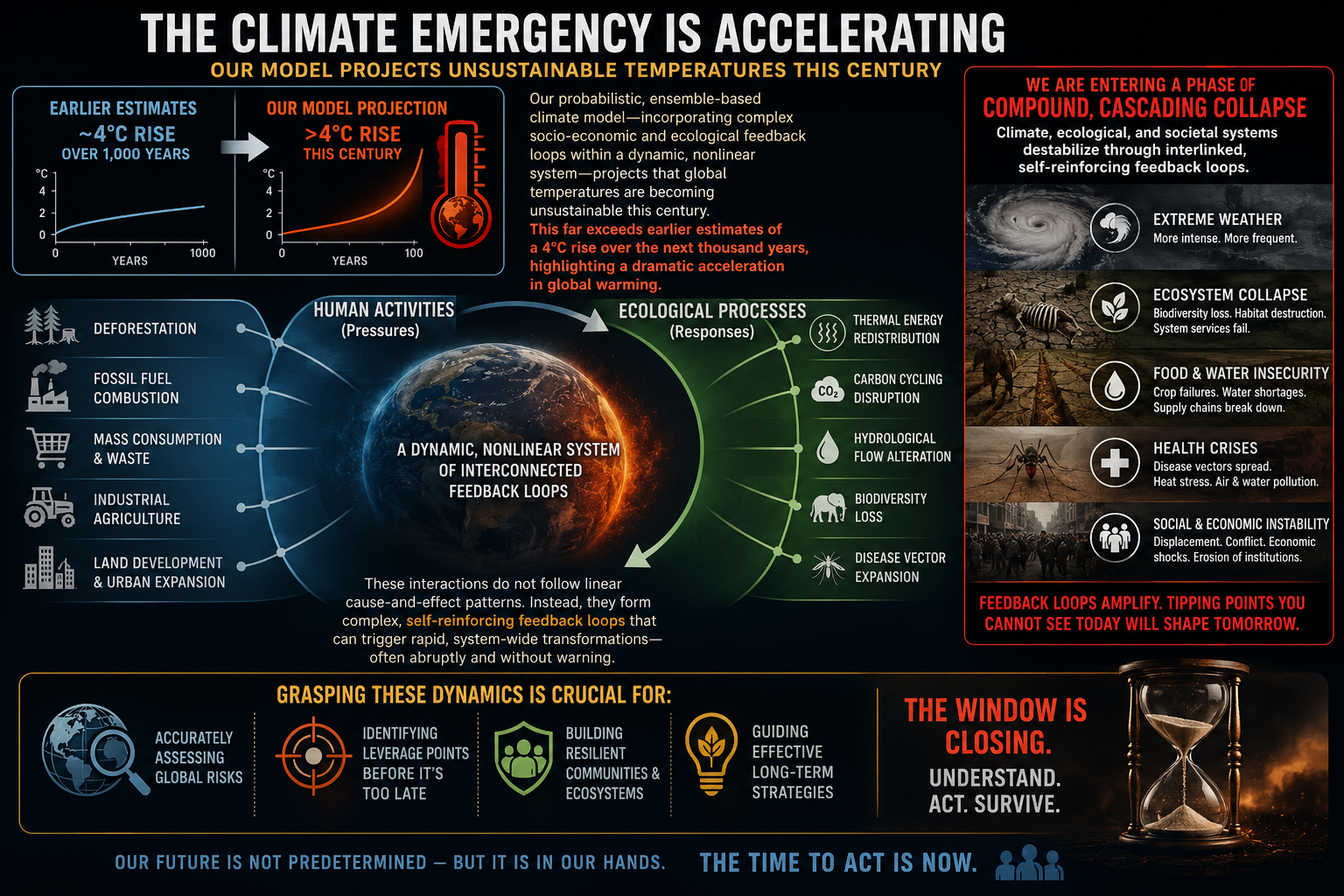
The Arctic is warming far faster than the global average, creating a cascading climate response that reaches far beyond the polar region. Accelerating glacial retreat, a slowing AMOC, rising sea levels, and increasingly severe local impacts are reshaping communities and ecosystems around the world.Greenland’s Giant Iceberg Rollover: A Dramatic Sign of a Rapidly Changing Arctic
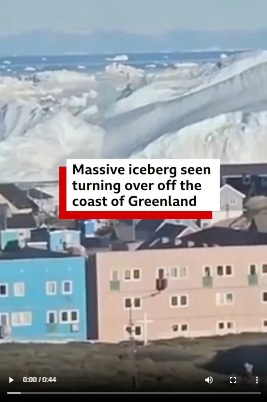
On July 25, 2026, a massive iceberg near Ilulissat, Greenland, dramatically rolled over in the ocean, sending a powerful surge of waves and mist toward the coastline. The spectacular event occurred near the UNESCO-listed Ilulissat Icefjord on Greenland’s western coast, where enormous icebergs regularly break away from one of the most active glacier systems on Earth.
As the giant block of ice rotated with tremendous force, it revealed a jagged, ancient underside that had been hidden beneath the ocean surface. Fortunately, no injuries or property damage were reported from the resulting waves.
Why Do Giant Icebergs Flip?
Icebergs are naturally unstable structures. They float with roughly 90% of their mass hidden below the waterline, and their shape changes continuously as they melt.
1. Uneven Melting Shifts the Center of Gravity
Icebergs often become unstable because melting does not occur evenly. Warmer ocean water can erode the submerged portion of the iceberg, while sunlight and warmer air melt the upper surface.
As the underwater shape changes, the iceberg’s center of gravity shifts. Eventually, the enormous ice mass becomes unstable and violently rotates until it reaches a new equilibrium.
2. The Ilulissat Region Is an Iceberg Hotspot
The event occurred near the terminus of Sermeq Kujalleq Glacier, one of the fastest-moving glaciers in the world.
This glacier feeds the Ilulissat Icefjord and has historically produced some of Greenland’s largest icebergs. Its rapid flow and frequent calving make the region one of the most dramatic locations on Earth to witness glacier change.
Why This Matters for Climate Change
Iceberg flips are a natural part of the iceberg life cycle, but climate change is altering the conditions that create and accelerate these events.
A Warmer Arctic Means Faster Ice Loss
The Arctic is warming much faster than the global average, causing:
- Faster glacier flow: Warmer temperatures increase ice loss and can accelerate glacier movement toward the ocean.
- More frequent calving: As glaciers lose mass, more large icebergs break away.
- More rapid underwater melting: Warmer ocean waters attack the submerged portions of icebergs, destabilizing them more quickly.
- Greater instability of ice structures: Rapid melting creates unusual shapes that are more likely to roll over.
Greenland’s ice sheet is now losing hundreds of billions of tons of ice each year, contributing to rising global sea levels. The surrounding Arctic Ocean is also warming rapidly, intensifying the processes that reshape Greenland’s glaciers and icebergs.
Melting Glaciers: Why Their Retreat Affects Everyone
The overwhelming interest in Greenland’s dramatic iceberg rollover has raised an important question: Why should people who live thousands of miles from a glacier care?
Glacial retreat reshapes nearby landscapes almost immediately, but its most significant impacts extend far beyond the Arctic. As glaciers disappear, the effects ripple through water supplies, food production, energy systems, coastlines, and the global economy.
Immediate Impacts Near Glaciers
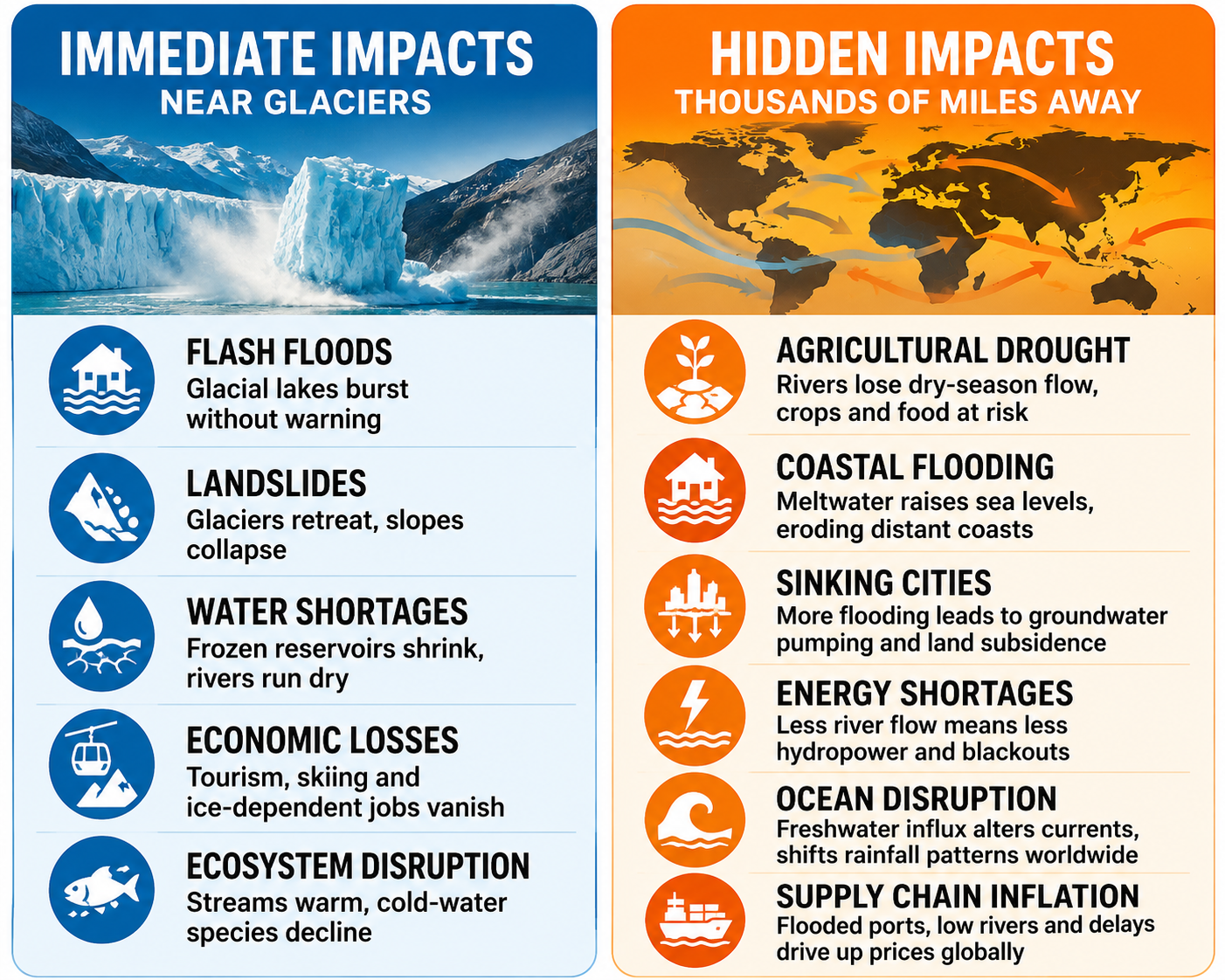
- Flash floods: Melting ice forms unstable glacial lakes that can burst without warning, devastating downstream communities.
- Landslides: As glaciers retreat, they remove the support that stabilizes steep mountain slopes, increasing the risk of massive rockfalls.
- Water shortages: Many communities lose the frozen reservoirs that supply rivers during the dry summer months.
- Economic losses: Glacier tourism, skiing, and other ice-dependent industries decline as glaciers disappear.
- Ecosystem disruption: Cold-water species, including trout and salmon, struggle as streams warm and habitats shrink.
Hidden Impacts Thousands of Miles Away
- Agricultural drought: Rivers fed by glaciers lose their dry-season flow, reducing irrigation water for farms far downstream.
- Coastal flooding: Meltwater from Greenland and other glaciers raises global sea levels, increasing flooding and shoreline erosion worldwide.
- Sinking cities: More frequent coastal flooding often leads to increased groundwater pumping, accelerating land subsidence in vulnerable urban areas.
- Energy shortages: Hydroelectric systems that depend on glacier-fed rivers face declining water supplies and reduced power generation.
- Disrupted ocean circulation: Large freshwater inputs can alter ocean currents, shifting weather patterns and rainfall across continents.
- Higher prices: Lower river levels, flooded ports, and damaged transportation infrastructure disrupt global supply chains, increasing the cost of food, energy, and consumer goods.
Glacial retreat is far more than the loss of scenic ice. It is a global chain reaction that affects freshwater, agriculture, infrastructure, ecosystems, economies, and the stability of the climate system. What begins with melting ice in Greenland ultimately influences the lives of billions of people around the world.
Glacial Retreat Severity
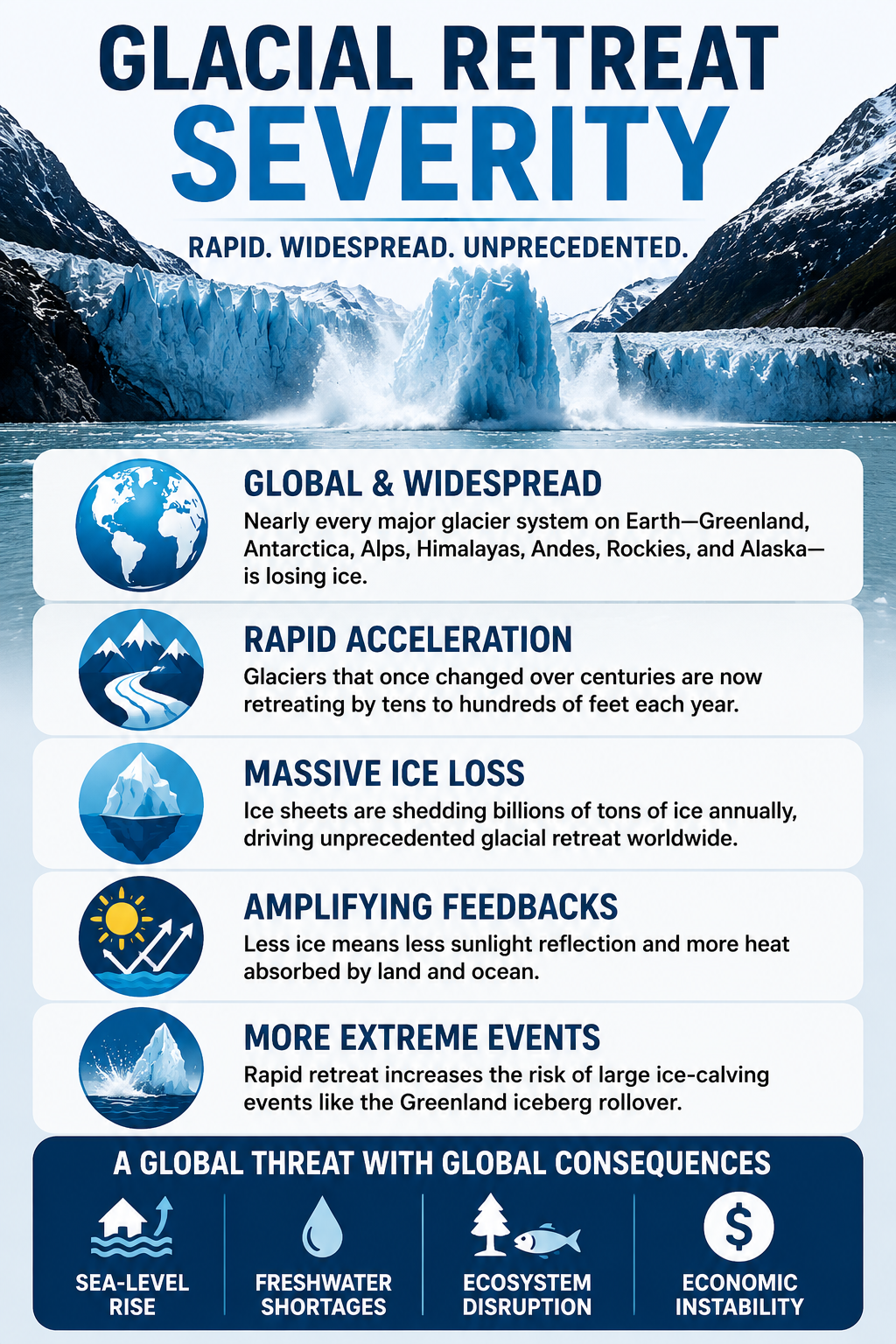
Glacial retreat is accelerating at an unprecedented rate as rising global temperatures drive record levels of melting. Nearly every major glacier system on Earth—from Greenland and Antarctica to the Alps, Himalayas, Andes, Rockies, and Alaska—has experienced sustained ice loss over recent decades. In many regions, glaciers that once changed slowly over centuries are now retreating by tens to hundreds of feet each year, while ice sheets are shedding billions of tons of ice annually. This rapid loss reduces Earth’s ability to reflect sunlight, exposes darker land and ocean surfaces that absorb more heat, and increases the likelihood of large ice-calving events like the recent Greenland iceberg rollover. As these feedback loops intensify, glacial retreat is no longer just a regional environmental issue—it has become a global driver of sea-level rise, freshwater shortages, ecosystem disruption, and economic instability.
Melting Ice Is Slowing Earth’s Ocean Conveyor Belt (AMOC)
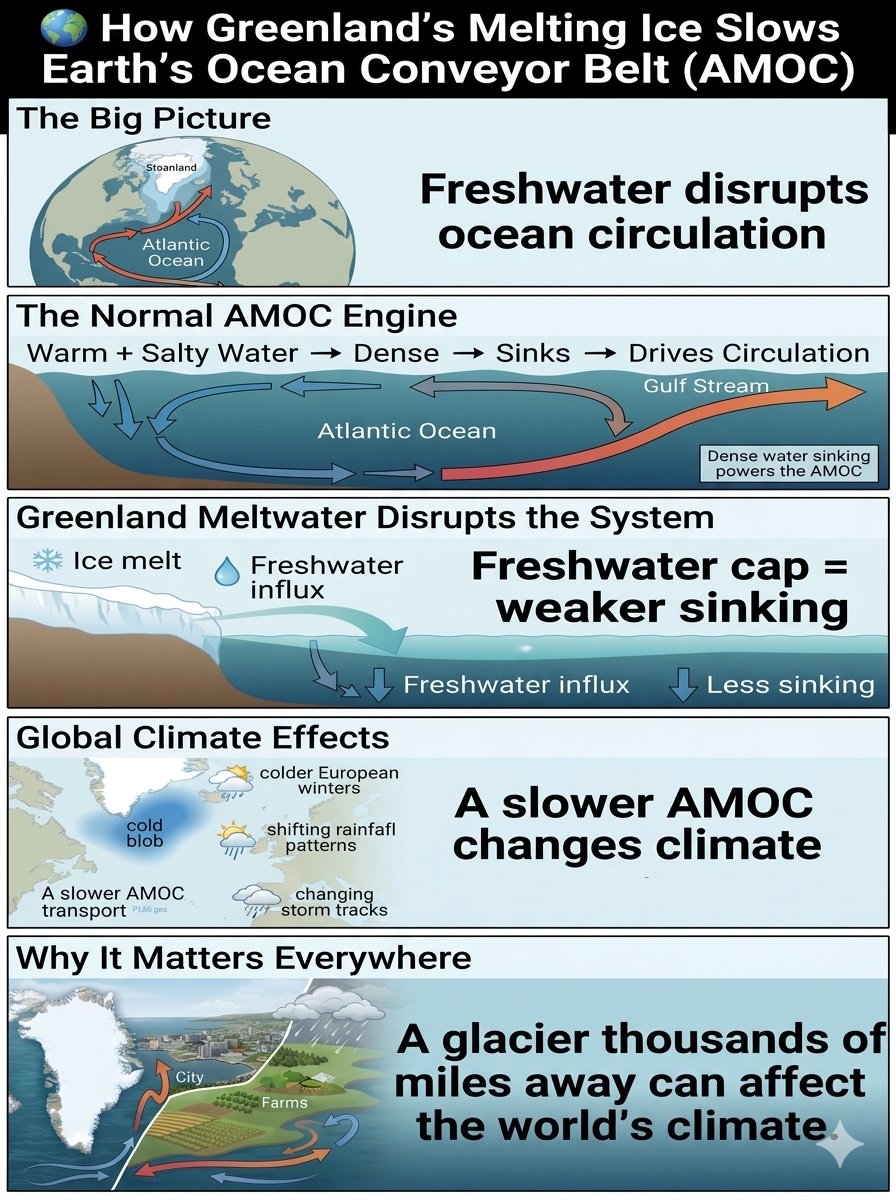
Glacial retreat is weakening the Atlantic Meridional Overturning Circulation (AMOC) by injecting enormous amounts of freshwater into the North Atlantic. This disrupts the natural “ocean conveyor belt” that redistributes heat around the planet and plays a critical role in regulating global climate patterns.
The Mechanics of the Slowdown
The AMOC depends on a delicate balance between temperature and salinity to maintain its circulation. Greenland’s accelerating ice loss is disturbing this balance through a chain reaction:
The Normal Engine: Sinking Water
Under normal conditions, warm, salty tropical water flows northward through the Gulf Stream into the North Atlantic. As this water reaches the subpolar regions near Greenland, it cools. Because cold, salty water is extremely dense, it sinks rapidly into the deep ocean.
This sinking motion acts like the engine of the AMOC, pulling more warm surface water northward while sending colder deep water back toward the tropics. This continuous cycle helps transport heat around the globe.
The Freshwater Cap
The accelerating retreat of the Greenland Ice Sheet is adding vast quantities of freshwater directly into these critical deep-water formation zones.
Unlike salty ocean water, freshwater is less dense. As meltwater accumulates at the surface, it creates a buoyant freshwater layer — sometimes described as a “cap” — that makes it more difficult for surface waters to sink.
Loss of Density: A Slower Conveyor
When surface waters cannot sink efficiently, the downward circulation weakens. The reduced sinking disrupts the entire AMOC system, slowing the transport of heat and altering ocean circulation patterns across the Atlantic basin.
Compounding Regional Feedbacks
The Atlantic “Cold Blob”
One of the most visible signs of AMOC weakening is a persistent region of unusually cold water south of Greenland and near the North Atlantic subpolar gyre, often called the Atlantic Cold Blob.
As the AMOC slows, less tropical heat is transported northward, creating a localized cooling pattern within an otherwise warming planet. This cold region acts as a fingerprint of changing ocean circulation.
Glacial Changes Beyond Greenland
The AMOC is not isolated from the rest of the planet. Research suggests that melting glaciers and ice sheets in other regions can influence global ocean salinity patterns.
Freshwater entering the Pacific Ocean from retreating glaciers and melting icebergs can alter large-scale ocean circulation pathways, potentially affecting the Atlantic system thousands of miles away.
Current Impact and Future Outlook
Observations indicate that the AMOC has weakened compared with conditions in the mid-20th century, although the exact magnitude of the slowdown remains an active area of scientific research because direct measurements of the full system only began recently.
Earlier climate discussions often focused on the possibility of a sudden, abrupt AMOC collapse. More recent high-resolution climate simulations generally suggest that Greenland meltwater is more likely to contribute to a progressive weakening rather than an immediate shutdown.
However, a substantial long-term slowdown would still have major consequences:
- 🌊 Changes in Atlantic heat transport
- ❄️ More extreme winter patterns in parts of Europe
- 🌧️ Shifts in tropical rainfall and monsoon systems
- 🌪️ Altered storm tracks and regional weather extremes
- 🌍 Greater disruption of Earth’s climate balance
The AMOC is a reminder that Earth’s climate system is not a collection of isolated parts. A glacier melting thousands of miles away can influence ocean currents, weather patterns, and societies around the world.
The fate of Greenland’s ice is not just an Arctic issue — it is a global climate signal.
Far Reaching Consequences
The Rhine River has fallen to historic low levels at several critical measuring stations, disrupting one of Europe’s most important transportation corridors. At Lobith, near the Dutch border, the river dropped to 6.47 meters above NAP, surpassing the previous record set during the severe 2022 drought. River discharge has also plunged to approximately 692 cubic meters per second as prolonged drought and depleted Alpine snowpacks sharply reduce water flowing downstream.
Shipping and Economic Impacts
The Rhine carries hundreds of millions of tons of cargo each year, making low-water events a major economic concern.
- Cargo restrictions: Freight vessels are operating at only 20% of normal capacity in some locations to avoid grounding on the riverbed.
- Critical bottlenecks: Water levels at the key shipping gauge at Kaub, near Koblenz, have fallen to around 25 centimeters, matching the record lows experienced in 2018.
- Rising costs: Reduced shipping capacity has significantly increased transportation costs, disrupted supply chains, and threatens economic growth across Central Europe.
Outlook
Over the coming years, communities that depend on glaciers for freshwater will face increasingly severe challenges, with more frequent and escalating states of emergency as these critical water reserves continue to decline.
Why Climate Change Is Making Low Rhine Levels More Common
While the Rhine has experienced low-water periods throughout history, climate change is fundamentally altering the river’s hydrology. Research from European hydrological agencies shows that rising temperatures and accelerating glacial retreat are removing the natural systems that historically sustained river flows during dry summers.
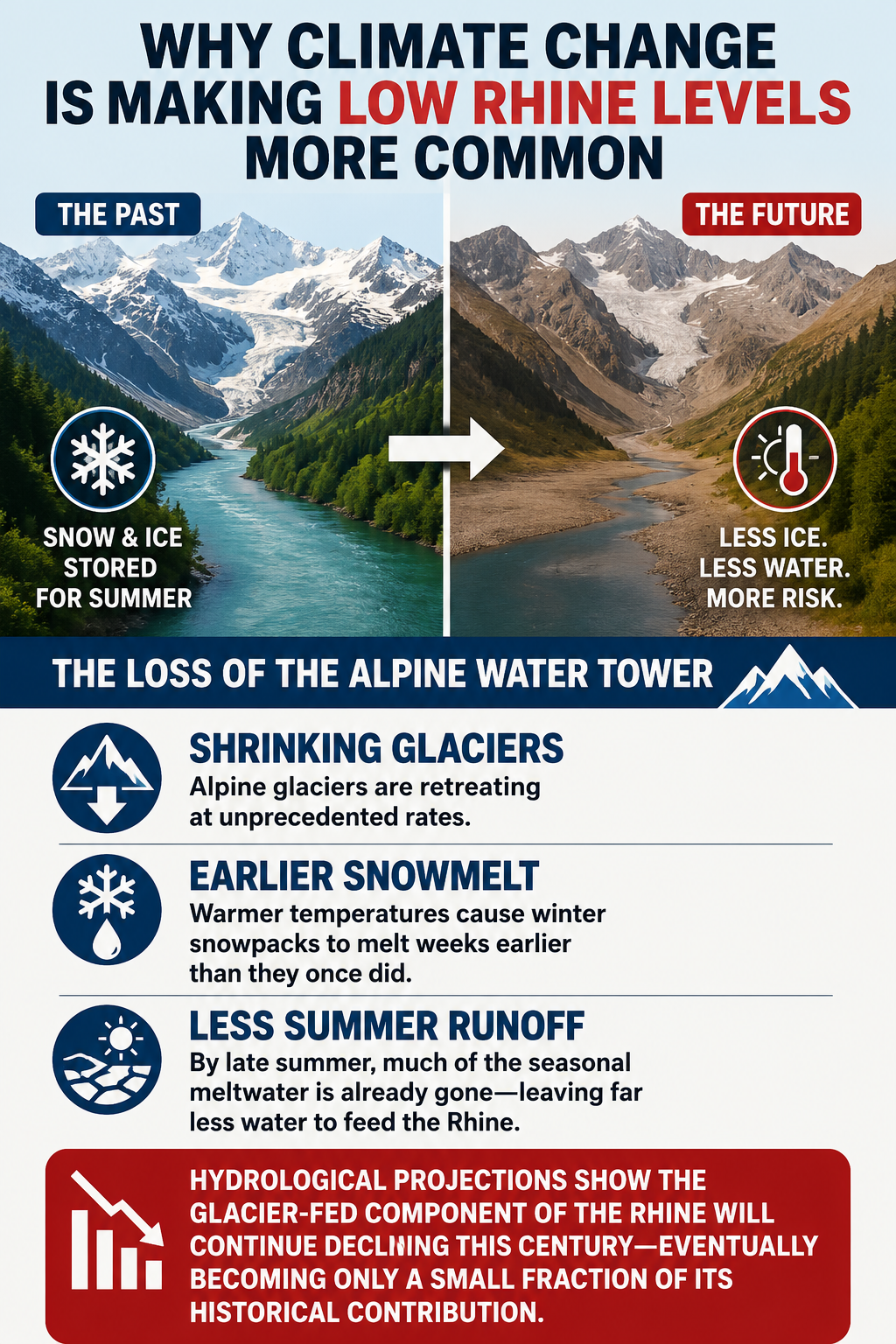
The Loss of the Alpine Water Tower
The Alps have long acted as Europe’s natural water reservoir, storing winter snowfall and glacier ice that gradually melted throughout the summer.
That natural buffer is rapidly disappearing.
- Shrinking glaciers: Alpine glaciers are retreating at unprecedented rates.
- Earlier snowmelt: Warmer temperatures cause winter snowpacks to melt weeks earlier than they once did.
- Less summer runoff: By late summer, much of the seasonal meltwater has already been exhausted, leaving far less water to feed the Rhine during periods of peak demand.
Hydrological projections indicate that the glacier-fed component of the Rhine will continue declining throughout this century, eventually becoming only a small fraction of its historical contribution.
A River Increasingly Dependent on Rainfall
As glacier and snowmelt decline, the Rhine is transitioning from a stable, meltwater-supported river into one increasingly dependent on rainfall.
This shift produces much greater variability:
- Wetter winters with more intense precipitation.
- Longer, hotter summer droughts.
- More frequent and severe low-water events.
- Increasing disruptions to commercial navigation and regional economies.
Without the stabilizing influence of Alpine snow and glacier melt, prolonged summer droughts now cause the Rhine to reach critical shipping thresholds far more quickly than in the past.
The Rhine’s record-low water levels are more than a short-term drought story—they illustrate how accelerating climate change is transforming Europe’s water resources. As glaciers continue to retreat and heatwaves become more frequent, extreme low-water events are expected to become increasingly common, posing growing risks to transportation, industry, agriculture, and water management across the continent.
Conclusion
Dramatic iceberg rollovers in Greenland provide a powerful visual representation of how rapidly the climate system is changing. These events are not isolated spectacles; they are symptoms of a larger transformation occurring across the cryosphere. As ice sheets and glaciers lose mass, the impacts extend far beyond the Arctic through interconnected feedback loops that amplify warming, disrupt ocean circulation, alter freshwater systems, and increase risks for communities around the world.
The Arctic is warming far faster than the global average, creating a cascading climate response that reaches far beyond the polar region. Accelerating glacial retreat, a weakening Atlantic Meridional Overturning Circulation (AMOC), rising sea levels, and increasingly severe local impacts are reshaping ecosystems, economies, and communities worldwide. The loss of long-stable ice reserves represents not only a change in landscapes, but a fundamental shift in the Earth's climate balance.
As glaciers and ice sheets continue to retreat, one of the most consequential outcomes is the transfer of billions of tons of land-based ice into the oceans. This process is accelerating sea level rise (SLR), threatening coastal communities, infrastructure, and ecosystems across the planet. Understanding the mechanisms driving ice loss is therefore essential to understanding the future trajectory of global sea levels.
Explore how melting glaciers, warming oceans, and nonlinear climate feedbacks are combining to reshape coastlines and redefine future risks through sea level rise: Climate Change and Sea Level Rise (SLR)
The Energy That Moves Mountains
- The Mountains Crumble to the Sea
- Nepal–Tibet: Glacier Loss, Permafrost Collapse, Glacial Lake Outburst Floods, Flash Floods, Mudslides and Avalanches
- The Nepal-Tibet Domino Effect: A Continuous Cascade of Failures
- Nepal-Tibet: Energy Like Wet Concrete
- Nepal-Tibet: Fluidization Physics
- Observe Tipping Points Topple → Climate Change Avalanche
- The Physics of When the Earth Starts Moving
- Greenland: 6,205 Gigatons of Ice Gone—and the Energy Behind It
- Kyrgyzstan Says, “You Cursed Brat. I’m Melting.”
Extreme Impacts: Extreme Weather Events | Violent Rain | Deadly Humid Heat | Sea Level Rise | Insurance
Ecosystems & Feedbacks: Ecosystem Collapse & Extinction Risks | Soil–Insect Climate Feedback Collapse | Insect Collapse | Soil | Trees & Deforestation
Human Health & Society: Climate Change Business & Economics | DIY Climate Control | Climate & Human Health | Climate Tax | Limits of Human Adaptability | Climate-Driven Health Collapse | Food & Water Security | Civilization Collapse