Heat-Triggered Flash Droughts: The Rapid Intensification of Heat, Drought, and Wildfire Risk
The Trend
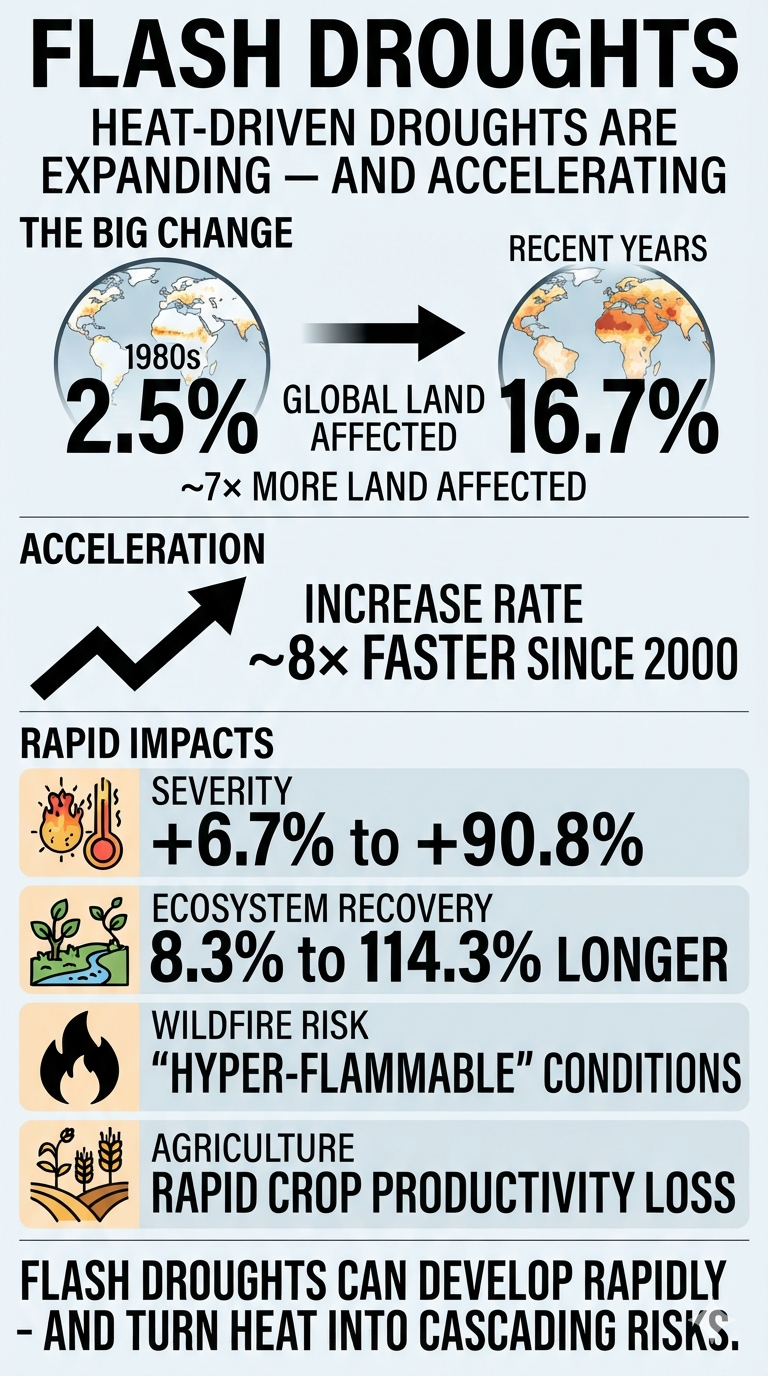
Flash droughts are one of the three fastest-accelerating climate extremes. The share of global land affected by heat-driven drought has expanded dramatically—from approximately 2.5% in the 1980s to 16.7% in recent years. The rate of increase has also accelerated, rising roughly eightfold since 2000.
This shift is important because heat-triggered droughts behave differently from conventional droughts. Rather than developing gradually over months or years, they can emerge within weeks, leaving agriculture, ecosystems, water managers, and communities with far less time to respond.
The Impact
Heat-triggered flash droughts are rapid-onset, severe moisture deficits initiated or intensified by extreme heat and unusually high atmospheric dryness, rather than simply by a prolonged lack of precipitation.
Think of the process as a high-powered hair dryer aimed at the landscape. Extreme heat and dry air rapidly pull moisture from vegetation and soils. As available moisture disappears, plants become stressed, agricultural productivity declines, wildfire danger rises, and water supplies can deteriorate—all on a timescale far shorter than that of conventional drought.
The result is a compound climate hazard in which heat and drought reinforce one another, producing impacts that can escalate rapidly.
The Mechanics of “Hair Dryer” Droughts
Conventional droughts often develop gradually, giving ecosystems and communities more time to adjust. Flash droughts can materialize within weeks, particularly when extreme heat coincides with atmospheric dryness.
1. Evapotranspiration Spike
Extreme temperatures combined with a high vapor pressure deficit (VPD) increase the atmosphere’s demand for moisture. Water is transferred from soil and vegetation into the atmosphere at an unsustainable rate.
This accelerated evapotranspiration rapidly depletes soil moisture and places plants under severe water stress.
2. Soil Overheating
Normally, evaporation of soil moisture helps cool the land surface. As soil moisture disappears, that evaporative cooling weakens.
The ground therefore heats more intensely, creating a feedback loop:
Less soil moisture → less evaporative cooling → hotter soil → greater plant stress → greater moisture loss
The result can be intense soil-temperature extremes that further damage vegetation and agricultural productivity.
3. Regional Differences
The development of heat-triggered flash droughts varies with regional climate and ecosystem characteristics.
In high-latitude and relatively wet regions, extreme heat can rapidly accelerate moisture extraction because vegetation and soils initially contain substantial amounts of water.
In subtropical regions, plants may respond by closing their stomata to conserve water. This can slow immediate moisture loss but also restrict photosynthesis and carbon uptake, increasing longer-term ecosystem stress.
Cascading Ecological Impacts
The combination of extreme heat and rapidly developing dryness can produce impacts substantially greater than those associated with conventional flash droughts.
| Metric | Heat-Triggered Flash Drought | Conventional Flash Drought |
|---|---|---|
| Severity | 6.7%–90.8% higher severity | Baseline severity |
| Ecosystem Recovery | 8.3%–114.3% longer recovery times | Normal recovery trajectory |
| Wildfire Risk | Can create “hyper-flammable” conditions | Elevated baseline fire risk |
| Primary Agricultural Impact | Can rapidly devastate cropland productivity | General agricultural stress |
These differences matter because ecosystems may not simply experience a more severe drought—they may experience a faster and more damaging transition from normal conditions to extreme environmental stress.
The Hyper-Flammability Multiplier
One of the most dangerous consequences occurs when a heat-triggered flash drought overlaps an existing conventional drought.
The slow drought has already depleted vegetation and soil moisture. The sudden arrival of extreme heat and atmospheric dryness then accelerates the drying process, pushing vegetation toward an exceptionally flammable state.
This creates a hyper-flammability multiplier:
Existing drought → Extreme heat + dry atmosphere → Rapid vegetation and soil drying → Loss of natural moisture + evaporative cooling → Hyper-flammable landscape → Faster-spreading, more intense wildfires
Once ignited, fires in these conditions can spread more rapidly, burn with greater intensity, and become substantially more difficult to contain.
A Rapidly Escalating Compound Hazard
Heat-triggered flash droughts demonstrate why temperature, atmospheric moisture, soil moisture, drought, and wildfire cannot always be treated as independent hazards.
Extreme heat can accelerate moisture loss. Moisture loss can increase land-surface temperatures. Hotter, drier vegetation becomes more flammable. Wildfires then add another layer of ecological and economic damage.
What once might have been a gradual drought can therefore become a rapidly escalating compound disaster—one capable of overwhelming agricultural, ecological, and emergency-response systems before communities have sufficient time to adapt.
The Four Main Types of Drought—and Where Flash Droughts Fit
Drought is not a single phenomenon. It can be classified according to where the water deficit occurs and how it affects the environment and society. Meteorological drought occurs when a region receives substantially less precipitation than its historical average over a defined period. Agricultural drought occurs when soil moisture falls below levels needed to support healthy plant growth, often intensified by high temperatures and accelerated evapotranspiration. Hydrological drought develops as prolonged water shortages reduce streamflow, river levels, reservoirs, lakes, and groundwater supplies. Socioeconomic drought occurs when limited water supplies begin affecting society, including drinking water, agriculture, energy production, industry, food prices, and other economic systems.
Where Do Flash Droughts Fit?
Flash drought is different from these four categories because it describes the speed and mechanism of drought development, rather than simply the sector or water reservoir being affected.
A flash drought can develop rapidly—often within weeks—when unusually high temperatures, atmospheric dryness, and accelerated evapotranspiration rapidly deplete soil moisture.
In other words, flash drought is best understood as a rapid-onset pathway into agricultural and potentially hydrological drought, rather than a completely separate fifth category.
Meteorological drought → reduced precipitation
Heat-triggered flash drought → extreme heat + atmospheric dryness → rapid moisture loss
Agricultural drought → depleted soil moisture → crop and vegetation stress
Hydrological drought → depleted streams, reservoirs, and groundwater
Socioeconomic drought → water shortages → impacts on people and the economy
Importantly, these pathways do not always occur in sequence. A flash drought can develop with little initial precipitation deficit when extreme heat and high atmospheric moisture demand rapidly extract water from soils and vegetation.
This is what makes heat-triggered flash droughts particularly dangerous: the landscape can transition from relatively normal conditions to severe agricultural and wildfire stress in a matter of weeks, leaving considerably less time for detection, adaptation, and response.
Extreme Impacts: Extreme Weather Events | Violent Rain | Deadly Humid Heat | Sea Level Rise | Insurance
Ecosystems & Feedbacks: Ecosystem Collapse & Extinction Risks | Soil–Insect Climate Feedback Collapse | Insect Collapse | Soil | Trees & Deforestation
Human Health & Society: Climate Change Business & Economics | DIY Climate Control | Climate & Human Health | Climate Tax | Limits of Human Adaptability | Climate-Driven Health Collapse | Food & Water Security | Civilization Collapse